Underwater Treasure Hunt Games: The Complete Guide
The treasure is never the hard part. Getting it home is — and that is the whole design of the sub-genre.

Treasure hunt games have a structural trick that most players do not notice until it has cost them a run: finding the treasure is never the hard part. Getting it home is. And a game that scores you the moment you touch a chest has thrown away the only interesting decision it had.
This guide covers how the sub-genre is built, why the return leg is the whole design, how carry limits and weight penalties are tuned, and how to play the risk–reward loop properly.
The loop
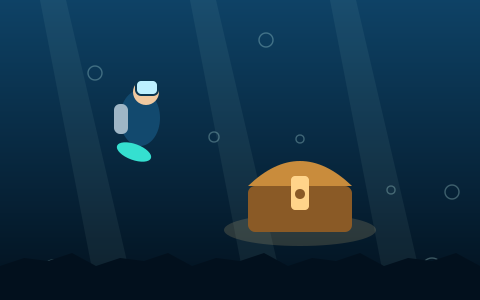
Every underwater treasure hunt game runs the same four-step cycle:
- Descend from a safe zone into a dive site, spending a resource as you go.
- Collect valuables, usually worth more the deeper and more dangerous they are.
- Return to the safe zone — slower and heavier than you left it.
- Bank the value, refill the resource, and decide whether to go again.
Step three is where the game lives. Remove it — score on pickup instead of on return — and you have a collection game, which is a perfectly good thing to be but a completely different one.
Why the return leg matters so much
Because it converts a series of independent decisions into a single compounding one.
In a score-on-pickup game, each chest is a separate small gamble. Take it or do not; the answer barely depends on what you did before. There is no tension, only optimisation.
With a return leg, every chest you take makes every subsequent decision worse. You are slower, so the swim home is longer. You are heavier, so it costs more. And crucially, the downside is no longer "lose this chest" — it is "lose everything you are carrying". Risk stops being additive and starts compounding, which is what makes the decision genuinely hard.
The player's mental model has to shift accordingly. You are not choosing chests; you are choosing a set of chests whose combined journey home you can afford.
The four dials that tune the loop
Ocean Treasure Hunt is a useful worked example because every number in it is legible.
1. Depth-scaled value
Chests are worth roughly 55 points near the top of the chest field and roughly 110 at the seabed, with the whole scale multiplied by a further 25% per level. That gradient is what makes going deeper rational rather than reckless — the game never has to tell you to take risks, because the payoff does it.
2. Depth-scaled cost
Oxygen drains at 3.4% per second just below the surface and 8.6% at the seabed. A two-and-a-half times swing. Time spent deep is disproportionately expensive, and it is expensive precisely when you are least able to afford it.
3. The carry limit
Three chests maximum. Without a limit, the optimal strategy is one enormous dive, and the game collapses into a single decision made once. With a limit, you get a rhythm of dives, and each one is a fresh judgement.
4. The carry penalty
Each chest makes the diver about 13% slower and adds weight fighting the ascent. This is the dial that makes the carry limit meaningful — without it, you would always take the maximum, and the limit would be a formality rather than a choice.
Together those four produce a genuinely non-obvious optimum, which is the whole point.
Why the third chest is usually wrong
Run the comparison properly.
Taking a third chest gains you its value — say 110 points at the seabed. It costs you a further 13% of your speed applied to the entire ascent, which is the longest and most oxygen-expensive segment of the dive, plus whatever time it took to reach it.
Meanwhile, banking two and immediately diving again starts the next dive with a full air meter, because crossing the surface line refills at 42% per second. So the "cost" of a second dive is mostly travel time, not risk.
And the failure modes are not symmetrical. Over-reaching and drowning does not cost you one chest — it costs all three, plus the dive.
The default should be two. Take the third only when it is close to your existing route and you are comfortably above your turn-back threshold, or when banking the load will clear a level target and trigger a full refill.
If you are unconvinced, run the two-chest drill: ten runs where you never carry more than two, and compare your average against your previous ten. Most players find the two-chest average higher.
The turn-back threshold
The rule, which works in any round-trip treasure game:
Turn back when the air you have left is less than the cost of the swim home, plus a third.
Applied to Ocean Treasure Hunt: a loaded ascent from the seabed takes roughly seven to eight seconds at an average drain around 6% per second, so it costs about 45% of your air. Add the third and the working threshold from the bottom with a full load is around 60%. From halfway up, roughly 30%. From just under the safe zone, almost anything survives.
The depth gauge on the right edge of the stage exists so you can make this judgement at a glance rather than by arithmetic. The air management guide works through it in more detail.
Routing a dive
The single biggest improvement available to most players is not better swimming — it is planning the ascent before the descent.
Decide which chests you are taking on the way down. Hunting for a third while already carrying two, at the bottom of the site, slow and heavy and burning air at the maximum rate, is how the overwhelming majority of runs end. That is a routing failure, not a skill failure, and it is entirely avoidable.
Two supporting habits:
Go deep first, on a full meter. The first dive after a level-up starts with 100% air. That is your longest dive, so spend it on the expensive chests at the bottom rather than the cheap ones near the top.
Treat hazards as a toll. Urchins cost 11% of your oxygen and push you away, but they cannot end a dive. Eleven percent is roughly two seconds of deep-water time — so if going around costs more than two seconds, go through.
The one-way variant
Deep Sea Diver is worth contrasting because it removes the return leg entirely, and everything changes.
There is no ascent, no banking and no way to lose accumulated score — depth accrues at three points a metre and stays. The tension moves from "can I get home" to "can I keep finding air", because air pockets get rarer with depth, from about 42% of spawned items down to a floor of 14%.
The instincts invert. In a round-trip game, restraint wins. In a one-way descent, the correct play below about 400 metres is to abandon the treasure entirely — pearls at 20 points are simply not worth the detour when a hundred more metres is worth 300.
Same theme, opposite strategy. It is worth knowing which you are playing before you develop habits.
Judging a treasure game quickly
When does value bank? On pickup or on return? On pickup means the design gave away its best decision.
Is there a carry limit? Without one, the optimal play is one enormous dive.
Is there a carry penalty? Without one, the carry limit is a formality and you will always take the maximum.
Does the resource drain scale with distance from safety? A flat timer makes depth free, which removes the entire risk gradient.
A game missing all four is a collection game wearing a treasure hunt's clothes.
Key takeaways
- Finding treasure is easy; the return leg is the actual design.
- A return leg makes risk compound rather than add — you lose the whole load, not one item.
- Four dials tune the loop: depth-scaled value, depth-scaled cost, carry limit, carry penalty.
- Two chests usually beats three, because the penalty applies to the most expensive segment.
- Turn back at roughly 60% air from the seabed with a full load.
- Plan the ascent before the descent; improvising at the bottom is how runs end.
- One-way descents invert the strategy entirely — there, treasure is the thing you skip.
Frequently asked questions
Why do I lose everything when I run out of air?
Because in a round-trip treasure game, value only counts once you carry it back across the safe-zone line. That is deliberate: it is what makes each additional chest a real decision instead of a free bonus.
Is it ever right to carry three chests?
Yes — when the third is close to your existing route and you are comfortably above your turn-back threshold, or when banking the load will clear the level target and trigger a full air refill. As a default it costs more than it returns.
Are deeper chests really worth more?
Substantially. Values run from about 55 points at the top of the chest field to about 110 at the seabed, and the entire scale is multiplied by a further 25% for each level you clear.
How do I know when to turn back?
Turn when your remaining air is less than the cost of the swim home plus a third. From the seabed carrying a full load that works out at roughly 60%; from halfway up, roughly 30%. The margin covers the things you cannot plan for.
Does the carry penalty really matter that much?
Yes, because it applies to the ascent — the longest and most oxygen-expensive part of the dive. Each chest costs about 13% of your speed, so a full load turns the swim home into genuinely slow work at exactly the point where oxygen is draining fastest.
Is there any real-world basis for these mechanics?
No. The air model is an arcade timer and the carry mechanics exist for game balance. Real underwater recovery work involves lift bags, decompression planning and surface support that none of this represents.
Where to go next
The practical companion is the air management guide, which covers the turn-back arithmetic and the three situations where the rule should be broken. For the routing half of the problem, the exploration strategy guide covers search patterns and positioning.
For a shorter read on the same theme, underwater treasure games and the risk–reward loop focuses purely on the decision itself.