 Underwater Adventure Games
Deep Sea Explorer
Pilot a submersible around an open water column, gather research samples and keep the hull intact before the survey clock runs out.
Visibility is limited to your dive light, so this is a navigation puzzle rather than a reaction test. The compass arrow gives bearing, the ping ring gives distance, and decoy debris makes you read shapes rather than guess.
Tip: turning your device to landscape gives this game a wider playfield.
Objective. Locate and recover as many rescue markers as you can before the clock expires. Each recovery adds time; faster recoveries are worth more points.
You pilot a small ROV through dark water. A radial mask limits what you can see to the area around your dive light, and that radius shrinks with every round — from about 150 pixels down to a floor of 80. Later rounds are almost entirely navigation by instrument.
Two sonar cues do the work. A gold arrow beside the ROV always points at the current marker, and an expanding ping ring fires faster the closer you get — roughly every 0.35 seconds when you are nearly on top of it, every 1.6 seconds when you are across the stage. A numeric distance read-out sits at the top of the stage, so the cue is never purely visual.
The marker itself is a white and coral ringed buoy labelled RESCUE. From round two onward, square grey objects labelled DEBRIS drift through the same water. They are told apart by shape and by label, not by colour. Touching one costs 2.5 seconds and nothing else — there is nothing hostile in this game.
Recovering a marker adds points and time and immediately starts the next round with a new marker placed at least a third of the stage away, so no round is ever solved by accident.
| Input | Action |
|---|---|
| Arrow keys or W A S D | Pilot the ROV |
| Hold left mouse button | Pilot toward the pointer |
| P or Esc | Pause and resume |
| Space or Enter | Start or restart |
| Gesture | Action |
|---|---|
| Drag anywhere | The ROV moves toward your finger |
| On-screen D-pad | Fixed-direction piloting |
Every game on this site also pauses with P or Esc, and pauses itself if you switch browser tabs mid-run. For a comparison of which input suits which game, see the underwater game controls guide.
By round five the dive light is small enough that you will reach the marker before you see it. Flying the arrow and ignoring the visuals is faster than trying to spot the buoy.
The arrow gives an exact bearing. There is never a reason to search in a pattern — point the ROV at the arrow and hold.
The ROV coasts. When the ping starts firing rapidly, ease off and let drag carry you in; circling a marker you keep flying past costs whole seconds.
The rescue marker is a ring; debris is a square. At a glance the silhouette is faster to read than the text, and both are faster than the colour.
The bonus loses 14 points a second. A recovery in four seconds is worth roughly double one in eleven — this is a game about direct routes.
By round twelve you are only getting four seconds back. Late rounds have to be solved in a handful of seconds, which is why the early rounds are where you build a buffer.
Follow the gold arrow beside the ROV — it always points at the current marker — and use the ping ring's rhythm plus the distance read-out at the top of the stage to judge range.
The rescue marker is a circular ring, white with a dashed coral overlay, labelled RESCUE. Debris is a grey square labelled DEBRIS. Shape and label both distinguish them, so colour vision is not required.
No. Nothing in this game is hostile. The clock is the only opponent, and touching debris costs 2.5 seconds and nothing more.
The dive light radius shrinks by about 9 pixels per round to a floor of 80, which shifts the game from spotting the marker to navigating by sonar.
No. It is an arcade abstraction. Real underwater search operations involve planned patterns, surface support and equipment this game does not model.
Underwater Adventure Games
Pilot a submersible around an open water column, gather research samples and keep the hull intact before the survey clock runs out.
 Diving Games
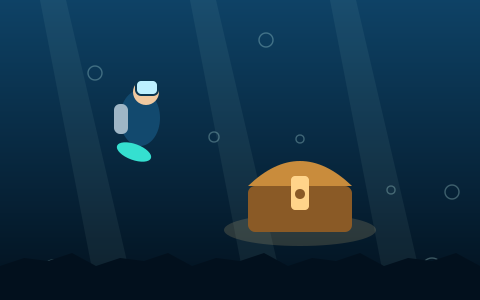
Dive for sunken chests, manage your air, and carry the haul back to the surface before it runs out — treasure only counts once it is banked.
 Underwater Challenge Games
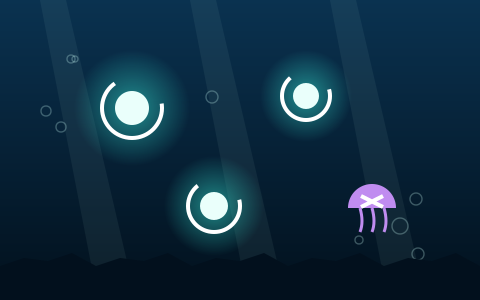
Tap the glowing plankton before they fade, leave the jellyfish alone, and watch your accuracy as closely as your score.
 Submarine Games
Thread a submarine through a winding canyon that narrows as you go, collecting energy cells and pushing your distance record.
 Diving Games
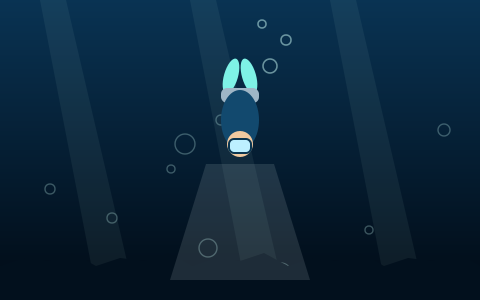
An endless descent. Steer past kelp and urchins, catch air pockets to keep breathing, and see how deep you can get.
 Underwater Challenge Games
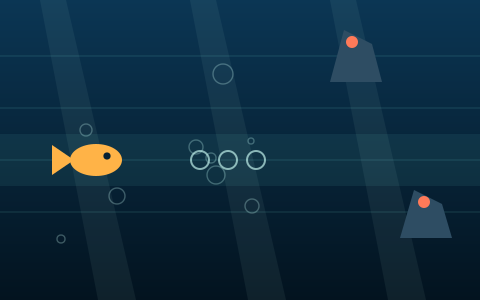
Four current lanes, rock spires in some and bubble strings in others. Switch lanes, keep the combo alive, keep going.
 Ocean & Marine Games
Match pairs of reef creatures against a shared clock across boards that grow from eight cards to twenty-four.