 Diving Games
Deep Sea Diver
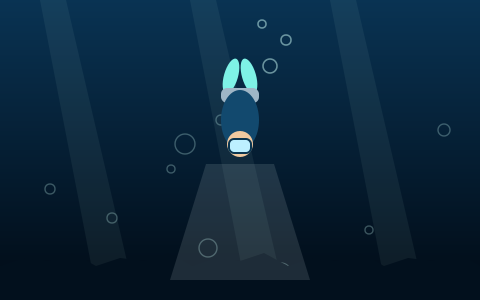
An endless descent. Steer past kelp and urchins, catch air pockets to keep breathing, and see how deep you can get.
A dive-and-return loop across a playfield two and a half screens deep. Deeper chests are worth more, carrying them slows you down, and oxygen drains faster the deeper you go. Every dive is the same question: one more chest, or turn back now?
Tip: turning your device to landscape gives this game a wider playfield.
Objective. Bank enough treasure value at the surface to clear each depth level, without letting your oxygen reach zero.
The playfield is roughly two and a half screens deep, with a vertical camera that follows the diver. The bright band across the top is the safe zone: everything above that dashed line refills your air at 42% per second and automatically banks whatever you are carrying.
Chests are scattered through the lower two thirds. Each one has its value printed underneath, and that value is set by depth — a chest at the seabed is worth roughly twice one at the top of the chest field, and every level multiplies the whole scale by a further 25%.
You can carry three chests at a time. Each one you pick up makes the diver 13% slower and noticeably heavier, so a full load turns the swim back up into genuine work. Nothing is scored until you cross the surface line — a diver who runs out of air while carrying three chests banks nothing at all.
Oxygen drains between 3.4% and 8.6% per second depending on how deep you are. Drifting purple urchins cost 11% of your air on contact and push you away, but they never end the dive directly; running the meter to zero is the only failure state.
Clear the level's banked-value target and the next depth opens: more chests, more urchins, a full air refill and a target 70% higher than the last one.
| Input | Action |
|---|---|
| Arrow keys or W A S D | Swim in eight directions |
| Hold left mouse button | Swim toward the pointer |
| P or Esc | Pause and resume |
| Space or Enter | Start or restart |
| Gesture | Action |
|---|---|
| Drag anywhere | The diver swims toward your finger |
| On-screen D-pad | Fixed-direction swimming |
| Tap Dive again | Restart |
Every game on this site also pauses with P or Esc, and pauses itself if you switch browser tabs mid-run. For a comparison of which input suits which game, see the underwater game controls guide.
The third chest adds a further movement penalty on the longest part of the swim. Unless the third is close and deep, banking two and coming straight back down is faster in total than hauling three.
Decide which chests you are taking on the way down. Hunting for a third while already carrying two — slow, heavy and burning air twice as fast at depth — is how most runs end.
Eleven percent of your oxygen is roughly two seconds of deep-water time. Sometimes taking the hit and swimming straight through is cheaper than the detour around.
A level-up refills your air completely, so the first dive of each level is your longest. Spend it going deep — that is when the expensive chests are cheapest to reach.
The gauge on the right edge tells you the swim distance home in one glance. Below about 45 m with a full load, turn around regardless of what you can see.
This is the one rule that decides the whole game. Twenty percent air and a long way down is not a gamble with a small downside — it is the entire run.
Chests only score once you carry them across the surface line. Running out of air while loaded banks nothing — that is the central risk of the game, and the reason the carry limit exists.
Swim above the dashed line at the top of the dive site. Air refills at 42% per second there, so a full recharge takes a little over two seconds.
Yes, substantially. Value scales with depth from roughly 55 points at the top of the chest field to roughly 110 at the seabed, and the whole scale multiplies by a further 25% per level.
No. They cost oxygen and knock you off course, but only an empty air meter ends a dive. Nothing in this game depicts injury.
No. Real diving involves decompression, gas mixes and buddy procedures that the game deliberately ignores, and the air model here is an arcade timer. Nothing in this game should be read as diving instruction.
Diving Games
An endless descent. Steer past kelp and urchins, catch air pockets to keep breathing, and see how deep you can get.
 Underwater Adventure Games
Pilot a submersible around an open water column, gather research samples and keep the hull intact before the survey clock runs out.
 Underwater Adventure Games
Follow the sonar through dark water to find each rescue marker before the clock runs out. The faster you find it, the more it is worth.
 Submarine Games
Thread a submarine through a winding canyon that narrows as you go, collecting energy cells and pushing your distance record.
 Underwater Challenge Games
Four current lanes, rock spires in some and bubble strings in others. Switch lanes, keep the combo alive, keep going.
 Ocean & Marine Games
Match pairs of reef creatures against a shared clock across boards that grow from eight cards to twenty-four.
 Underwater Challenge Games
Tap the glowing plankton before they fade, leave the jellyfish alone, and watch your accuracy as closely as your score.