Underwater Exploration Strategy: Search Patterns That Work
Four search patterns, when each one is right, and why holding the centre beats sweeping the edges in almost every open-water game.
Exploration games hand you a space rather than a track. There is no lane to hold and no correct line — you decide where to go and in what order, and that decision is worth more than any amount of steering skill.
This guide covers the search patterns that work in open-water games, why the obvious one is usually the worst, how to read a sonar instead of your eyes, and how to route between multiple objectives efficiently. It applies to Ocean Rescue Challenge, Deep Sea Explorer and the search half of Ocean Treasure Hunt.
The centre-holding principle
Start with the single most useful idea in the category, because everything else is a refinement of it.
When objectives can appear anywhere and you do not know where the next one will be, wait near the middle.
The reasoning is geometric. If a target is equally likely anywhere on a rectangular playfield, your expected distance to it is minimised from the centre and maximised from a corner. On a typical stage, sitting mid-field roughly halves your average travel distance compared with sitting against an edge.
This feels passive, and players resist it for that reason. It is not passive — it is positioning. In Deep Sea Explorer, where samples spawn continuously across the whole water column, holding a loose centre and taking whatever appears nearest will out-score sweeping the perimeter every single time.
The corollary matters just as much: after collecting something at the edge, drift back toward the middle rather than waiting where you are. Every second spent parked in a corner is a second of worse expected position.
Four search patterns and when each is right
When you do have to search rather than wait, there are four patterns worth knowing. They are not equally good, and the one most players use by default is the worst.
1. Random walk — almost never correct
Wandering wherever looks interesting. It is what everyone does instinctively, it covers ground redundantly, and it has no completion guarantee. The only time it wins is when the playfield is small enough that coverage does not matter.
2. Expanding spiral — good when you have no directional information
Start where you are and circle outward. This is genuinely optimal when the target is likely to be near your current position and you have no bearing — which is the situation in a lot of hidden-object games.
It is wrong in Ocean Rescue Challenge, because that game guarantees the next marker is at least a third of the stage away from you. The area immediately around you is the one place it definitely is not.
3. Lawnmower sweep — reliable and slow
Traverse in parallel lines until the whole field is covered. It guarantees you will find the target and it is the slowest guaranteed method. Worth using only when the clock is generous and you have no bearing information at all.
4. Direct bearing — use it whenever it is available
Point at the target and go. Obviously optimal, and available more often than players realise. If the game gives you any directional cue — an arrow, a ping rate, a sound, a gradient — the correct pattern is always "fly the cue".
The mistake is not trusting it. In Ocean Rescue Challenge the dive light shrinks every round, and by round five you will physically reach the marker before you can see it. Players keep sweeping because they expect to spot the target; the arrow was correct the whole time.
Reading an instrument instead of the picture
Ocean Rescue Challenge gives you three cues, and they are redundant on purpose so that no single one has to be perfect.
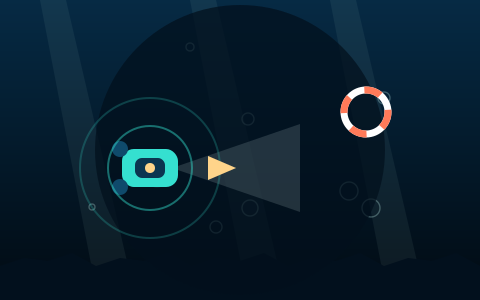
The bearing arrow sits beside the ROV and always points at the current marker. It is exact. There is never a reason to search in a pattern while it is on screen.
The ping ring expands from the ROV at a rate that scales with proximity — roughly every 0.35 seconds when you are nearly on top of the marker, every 1.6 seconds when you are across the stage. You do not read this as a number; you read it as a rhythm. Accelerating rhythm means closing.
The distance read-out at the top of the stage gives you a figure. It exists so the cue is never purely visual, and it is the one to glance at when you suspect you have overshot.
The practical technique: fly the arrow, listen to the rhythm, and ease off when the pings tighten. The ROV coasts, and circling a marker you keep flying past costs whole seconds off a speed bonus that decays at 14 points per second.
Telling targets from decoys
From round two onward, drifting debris shares the water with the rescue marker. Touching a decoy costs 2.5 seconds and nothing else — there is nothing hostile in the game — but 2.5 seconds is a meaningful chunk of a 55-second clock.
The two objects are distinguished three ways, in order of how fast your eye can use them:
- Silhouette. The rescue marker is a ring; debris is a square. At speed this is the fastest discriminator, and it works regardless of colour vision.
- Label. RESCUE versus DEBRIS, printed beside each object.
- Colour. White and coral versus grey — useful, but deliberately never the only signal.
Train yourself on the silhouette. Reading the label takes a fixation; reading a ring versus a square does not.
Routing between multiple objectives
When several objectives are visible at once, the question stops being "which is nearest" and becomes "what order".
The heuristic that works in practice: go to the nearest item that leaves you nearest the next one. That is a one-step lookahead, and it is enough. Full route optimisation is not worth the cognitive cost in a game that ends in ninety seconds.
Two refinements:
Expiring items outrank valuable ones. In Deep Sea Explorer the gold beacon lives for nine seconds and returns eight seconds of clock. Nothing else on the stage is worth more, and nothing else disappears. Drop whatever you were doing.
Decide while travelling. Pick your next two targets while still moving toward the first. Deciding on arrival costs roughly a second of hovering, every single time, and over a two-minute run that is most of the gap between an average score and a good one.
Momentum in an open field
All three exploration games use the same handling model: thrust accelerates, drag slows, and releasing the controls leaves you drifting.
The technique that follows is tap and coast. Press a direction for roughly two thirds of the distance, release, and let drag deliver you onto the target. Holding all the way arrives fast and overshoots, and then you spend a second correcting — the same second you were trying to save.
Mouse or touch drag handles this for you, which is why it is the better input in every exploration game on this site. Dragging specifies a destination and the craft decelerates into it on its own. The controls guide covers the comparison in full.
Playing with the lights off
Ocean Rescue Challenge narrows your dive light by about nine pixels per round, from roughly 150 down to a floor of 80. That shift is deliberate: the game starts as a spotting exercise and becomes an instrument-flying exercise.
Three adjustments as the light closes in:
- Stop scanning. Sweeping your eyes across a dark stage is wasted effort. Watch the arrow.
- Expect decoys you cannot see. By round six there may be several drifting objects in the dark. Flying the exact bearing at full speed will occasionally cost you 2.5 seconds; that is cheaper than slowing down.
- Bank time early. The clock refund per recovery starts around eleven seconds and shrinks by about 0.6 per round to a floor of four. The buffer you build in rounds one to five is what carries you through rounds ten and beyond.
Three drills
The centre drill. One run of Deep Sea Explorer where after every pickup you deliberately drift back toward the middle of the stage before choosing the next target. Count your samples against a normal run.
The arrow-only drill. One run of Ocean Rescue Challenge where you never look anywhere except the bearing arrow and the ROV. No scanning at all. Most players find this their best run within three attempts.
The lookahead drill. One run where you say out loud which target you are going to next while still travelling to the current one. Saying it forces the decision to happen early, which is the entire point.
Key takeaways
- Hold the centre when you do not know where the next objective will appear — it halves your average travel distance.
- Use a direct bearing whenever the game gives you one. Never sweep while an arrow is on screen.
- Expanding spirals are wrong in games that guarantee a minimum spawn distance.
- Read decoys by silhouette first, label second, colour last.
- Route with a one-step lookahead: nearest item that leaves you nearest the next.
- Expiring objectives outrank valuable ones. Always take the beacon.
- Tap and coast. These craft decelerate for you if you let them.
Frequently asked questions
What is the best search pattern in an underwater exploration game?
A direct bearing, whenever the game provides one. When it does not, an expanding spiral is best if the target is likely to be near you, and a lawnmower sweep is the reliable but slow fallback. A random walk is almost never correct.
Why does holding the centre of the stage work?
Because if targets are equally likely anywhere, your expected distance to the next one is lowest from the middle and highest from a corner. On a typical stage it roughly halves your average travel compared with sitting against an edge.
How do I find the marker in Ocean Rescue Challenge when it is too dark to see?
Fly the gold arrow beside the ROV — it always points at the current marker. Use the ping ring's rhythm to judge range and glance at the distance read-out at the top of the stage if you think you have overshot. By the later rounds you will reach the marker before you can see it.
Should I always go for the highest-value target?
No — go for the expiring one. A gold beacon in Deep Sea Explorer returns eight seconds of clock and disappears after nine, which makes it worth more than several ordinary samples and makes it the one item you should always detour for.
Is it worth avoiding decoys entirely?
Not at the cost of a detour. A decoy costs 2.5 seconds; steering wide around one in the dark often costs more than that, plus the speed bonus decay on the recovery you are racing toward. Fly the bearing and accept the occasional bump.
Where to go next
Exploration and air management are the two halves of Ocean Treasure Hunt, so the air management guide is the natural companion to this one. For the wider category, see underwater exploration games: a complete guide, or browse the adventure games category.