 Diving Games
Ocean Treasure Hunt
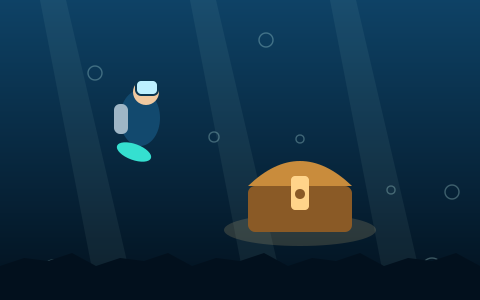
Dive for sunken chests, manage your air, and carry the haul back to the surface before it runs out — treasure only counts once it is banked.
The water column scrolls upward continuously, so depth only ever increases. Oxygen is the sole failure condition and air pockets get rarer the deeper you go — the descent is a supply problem as much as a steering one.
Tip: turning your device to landscape gives this game a wider playfield.
Objective. Descend as far as possible. Oxygen drains constantly and faster with depth — catch air pockets to keep going and collect pearls for score along the way.
The diver descends automatically, head-first, while the water column scrolls upward past them. You steer left and right, and you control the rate of descent: holding up brakes to 42% of the base rate, holding down powers into a kick at 185%. On a phone, dragging below the diver does the same thing as holding down.
Every 180 metres is a new tier. The base descent rate increases, oxygen drains a little faster, hazards spawn more often, and — the important one — air pockets become rarer. The chance an item is an air pocket starts at 42% and falls toward a floor of 14%, so the deeper you are, the more of the screen you have to cover to stay alive.
White pearls are pure score, worth 20 points plus 5 per tier. Bubble-shaped air pockets marked AIR restore 26% oxygen. Drifting urchins and kelp knots cost 14% oxygen and shove you sideways, with a two-second cooldown so a tangle cannot drain you instantly.
There is no crash and no injury. The dive ends when the oxygen meter reaches zero, and depth is what you are really competing against.
| Input | Action |
|---|---|
| Left / Right, or A / D | Steer across the water column |
| Up arrow / W | Brake — descend at 42% speed for fine positioning |
| Down arrow / S | Power kick — descend at 185% speed |
| Hold left mouse button | Steer toward the pointer; hold below the diver to kick |
| P or Esc | Pause and resume |
| Gesture | Action |
|---|---|
| Drag left or right | Steer |
| Drag well below the diver | Power kick downward |
| On-screen D-pad | Steer and control descent rate |
Every game on this site also pauses with P or Esc, and pauses itself if you switch browser tabs mid-run. For a comparison of which input suits which game, see the underwater game controls guide.
The brake exists so you can line up an air pocket that is not directly below you. Kicking past one because you were going too fast is the most common way a promising run ends.
Items enter from the bottom of the screen, so you can always see the next one or two. Pick your lateral position for the one after next, not the one you are about to take.
Air pockets are down to roughly one in five items by then. A pearl is 20-odd points; running dry costs you every point you would have earned from the next hundred metres.
A hazard costs 14% oxygen; an air pocket gives back 26%. If the only route to the air is through a kelp knot, going through is still net positive.
The efficient pattern is: kick hard through empty water, brake into each pickup, kick again. Constant maximum speed reads as more depth but usually produces less, because you miss air.
New items spawn anywhere across the width. Sitting mid-column halves your average lateral travel — the same logic that applies in Deep Sea Explorer.
There is no floor and no ending. The air-pocket rate bottoms out at 14% rather than reaching zero, so depth is limited by how efficiently you can find air while the descent keeps accelerating.
Only oxygen reaching zero. There is no collision death, no injury and no bottom to hit. Hazards cost air and push you around, nothing more.
Air pockets get rarer every 180 m while oxygen drains faster. Around the third and fourth tier the supply curve crosses the demand curve, and pearls stop being affordable.
No — it is an arcade number. Real breath-hold and scuba diving depths are limited by physiology and gas physics in ways this game does not model at all. See the fact-checking policy for how real-world claims are handled on this site.
The tier increases never stop, but each one is small. The practical ceiling comes from reaction time at high descent rates, not from a difficulty wall.
Diving Games
Dive for sunken chests, manage your air, and carry the haul back to the surface before it runs out — treasure only counts once it is banked.
 Underwater Challenge Games
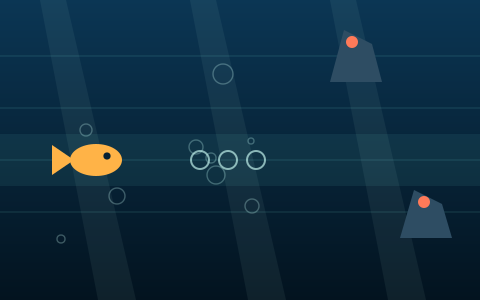
Four current lanes, rock spires in some and bubble strings in others. Switch lanes, keep the combo alive, keep going.
 Underwater Adventure Games
Pilot a submersible around an open water column, gather research samples and keep the hull intact before the survey clock runs out.
 Submarine Games
Thread a submarine through a winding canyon that narrows as you go, collecting energy cells and pushing your distance record.
 Underwater Adventure Games
Follow the sonar through dark water to find each rescue marker before the clock runs out. The faster you find it, the more it is worth.
 Ocean & Marine Games
Match pairs of reef creatures against a shared clock across boards that grow from eight cards to twenty-four.
 Underwater Challenge Games
Tap the glowing plankton before they fade, leave the jellyfish alone, and watch your accuracy as closely as your score.