 Underwater Challenge GamesFeatured
Underwater Obstacle Run
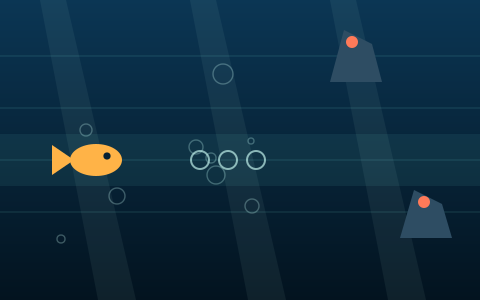
Four current lanes, rock spires in some and bubble strings in others. Switch lanes, keep the combo alive, keep going.
Short-session games with a single number at the end. Endless runs, timed objectives and reaction tests — the part of the library built for beating your own best rather than finishing anything.
Challenge games end with a single number, and the interesting question is what that number actually measures. Distance measures consistency. A combo multiplier measures route planning. A reaction score measures how fast you commit to a decision. Two games can hand you a score out of the same range and be testing completely different things.
These are the shortest games on the site — most runs finish in two to four minutes — and the most re-playable, because the failure is always legible. You know exactly which lane you should have taken, which is precisely why you start again.
All of them save your personal best in your own browser, and none of them have a leaderboard. You are competing with your previous run, which in this genre is usually the more interesting opponent anyway.
This category covers:
Underwater Challenge GamesFeatured
Four current lanes, rock spires in some and bubble strings in others. Switch lanes, keep the combo alive, keep going.
2 games in this category.
Underwater Challenge Games
Four current lanes, rock spires in some and bubble strings in others. Switch lanes, keep the combo alive, keep going.
 Underwater Challenge Games
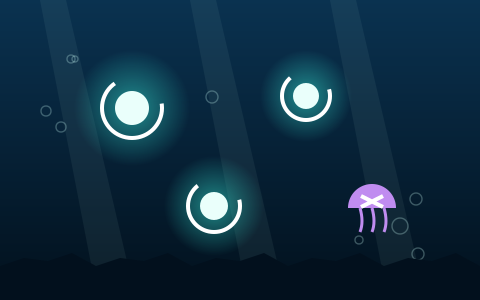
Tap the glowing plankton before they fade, leave the jellyfish alone, and watch your accuracy as closely as your score.
Challenge games hand you a single number at the end. What that number measures differs far more than the genre label suggests.
Most browser games claim mobile support. These are the underwater games where the touch scheme was designed rather than bolted on.
Reflex games are easy to design badly. These get the two things right that matter: a visible deadline and a penalty worth avoiding.
What makes a game genuinely short-session friendly, and the underwater games that clear the bar.
Your 340 ms in a browser game is not your reaction time. Here is what it actually measures and how to make it smaller.
Good obstacle games are solvable on sight. Learning to look at the far edge instead of the near one is most of the skill.
Challenge games rarely score the thing players think they score. It is worth checking before you spend an hour optimising the wrong behaviour.
In a combo-driven game, survival is not the score — the multiplier is. A cautious four-minute run at a x1 multiplier will lose to a reckless ninety-second run at x6. In a reaction game, the score is reaction time, not hit count, so the player who takes an extra beat to be sure is throwing away most of the value of each hit.
In distance-driven games the opposite applies: nothing beats staying alive, and every pickup that requires a detour is a gamble with terrible odds at high speed tiers.
The high score guide breaks down each scoring system on this site, game by game, with the multipliers and caps.
Short-session games with a single number at the end. Endless runs, timed objectives and reaction tests — the part of the library built for beating your own best rather than finishing anything.
There are 2 games in this category right now: Underwater Obstacle Run, Underwater Reflex. All of them are original HTML5 games written for this site.
Yes. Every game on this site is free, runs in the browser, and needs no account, no download and no plugin. Scores are saved in your own browser's local storage.
Yes. Every game in this category supports touch as a designed control scheme rather than an afterthought, and the playfield resizes when you rotate the device. Landscape gives you more room but nothing requires it.
Start with the featured game at the top of this page — it is the one that explains the category's core idea fastest. If you have never played an underwater arcade game before, the beginner's guide suggests an order for the whole library.