Beginner's Guide to Underwater Games
A first-hour plan. Which game to open first, what to practise in it, and the three habits worth building before you chase a score.

There are eight games on this site and no obvious order to play them in. Opened at random, several of them will hand a new player a bad first impression — Underwater Reflex in particular is brutal if it is the first underwater game you have ever touched, and Submarine Adventure will end four runs in a row before you work out what you are doing wrong.
Played in the right order, none of that happens. Each game in this sequence teaches one mechanic that the next one assumes you already have. This guide is that sequence, plus what to actually practise in each one and how to tell you are improving.
It takes about an hour. If you only have ten minutes, play step one and stop.
Before you start
Read the how to play guide first if you have not already — it covers the shared interface, the HUD and the three control schemes in about four minutes, and everything below assumes it.
One habit to adopt immediately: finish the run. New players abandon runs constantly, restarting the moment something goes wrong. That feels efficient and it is the single biggest obstacle to improving, because the last thirty seconds of a bad run is where the difficulty actually lives. Play it out.
Step 1 — Underwater Obstacle Run (10 minutes)
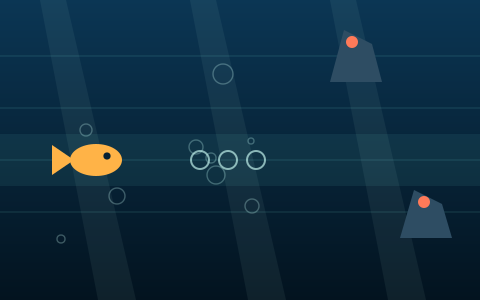
Underwater Obstacle Run is the simplest game on the site and the right place to begin. Four lanes, two buttons, one rule: some lanes are blocked and at least one is not.
What it teaches: looking ahead. This is the foundational skill for the entire library, and this game isolates it completely because there is nothing else to think about. Your fish does not have momentum worth managing and you cannot miss a jump. All you do is decide which lane, and the only way to decide well is to look at the right-hand edge of the stage rather than at your fish.
Practise this: deliberately keep your eyes on the right edge for a whole run. It feels wrong and your first two runs will be shorter than usual. By the fourth or fifth run your distance will be noticeably better than it was when you were watching yourself.
You have got it when: you pass 300 metres without a panicked double lane change. Ignore your score for now; the combo multiplier is a step-two concern.
Step 2 — Marine Match Challenge (10 minutes)
Marine Match Challenge is the only game here with no time pressure on individual actions, which makes it the right second stop. It is a pair-matching memory game across boards that grow from eight cards to twenty-four.
What it teaches: that a combo multiplier is worth protecting. Two consecutive matches gets you to x2, and by eight in a row you are at x5 — meaning each match scores five times as much as it did at the start. This is the first game where you will feel the difference between "playing" and "playing for score", and it lets you feel it without any reflex requirement at all.
Practise this: on each new board, turn over cards in reading order — left to right, top to bottom — instead of clicking wherever your eye lands. You will take several mismatches doing this, which feels like losing. Then you will clear the entire board in one unbroken streak at x5, and the total will be far higher than a cautious random approach ever produces.
You have got it when: you reach the third board (4x4) with time to spare.
Step 3 — Deep Sea Explorer (15 minutes)
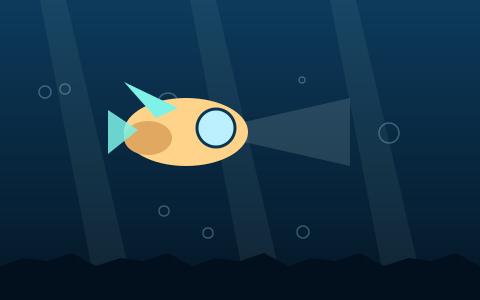
Deep Sea Explorer is the first game with real physics, and it is the one most worth spending time on. You pilot a submersible around an open water column, collecting samples before a survey clock runs out.
What it teaches: momentum. The submersible accelerates rather than moving, water drag slows it down, and a slight negative buoyancy pulls it downward whenever you stop steering. Almost every remaining game on this site uses the same handling model, so the half hour you spend getting comfortable here pays off four more times.
Practise this: the tap-and-coast. Press a direction for roughly half a second, let go, and let drag carry you onto the target. Compare that against holding the key all the way — you will overshoot nearly every time. Then try the same thing with mouse-drag, which most players end up preferring.
Also practise: going for the gold beacon. It is worth eight seconds of survey time and only lives for nine seconds, so it is almost always worth crossing the entire stage for. New players routinely ignore it because it is further away than the nearby samples. That is the wrong call, and learning to recognise a high-value detour is a skill that matters in half the library.
You have got it when: you finish a run because the clock ran out rather than because the hull did.
Step 4 — Deep Sea Diver (15 minutes)
Deep Sea Diver introduces the mechanic that defines the whole diving category: a resource that drains whether or not you are doing anything useful.
What it teaches: resource management, in its simplest form. You descend continuously, oxygen drains continuously, and bubble-shaped air pockets restore 26% of it. Nothing here can kill you — hazards cost air and push you around, but the only failure is an empty meter.
The clever part is that air pockets get rarer the deeper you go, dropping from about two in five items down to about one in seven. So the deeper you are, the more of the screen you have to cover to survive, at exactly the point when you are moving fastest.
Practise this: use the brake. Holding up slows your descent to 42% of normal, and it exists precisely so you can line up an air pocket that is not directly below you. New players tend to treat "go faster" as the whole game and kick past the air they needed.
You have got it when: you pass 400 metres. At that depth you will have stopped collecting pearls, which is correct — that decision is the game.
Step 5 — Ocean Treasure Hunt (10 minutes)
Ocean Treasure Hunt combines everything so far and adds the hardest idea in the library: value you have not banked is worth zero.
What it teaches: the turn-back decision. You dive for chests, you can carry three, each one makes you slower and heavier, and nothing scores until you swim back up across the surface line. Running out of air with a full load banks nothing at all.
Practise this: bank two chests rather than three, repeatedly, and watch what happens to your total. Almost every new player over-reaches here, because the third chest is visibly right there and the air meter is "probably fine". It usually is not.
You have got it when: you clear the first depth level. If you want the arithmetic behind the decision, the air management guide works through it properly.
The remaining three
After that hour, the rest of the library is approachable in any order.
Submarine Adventure is the momentum lesson from step three, applied at speed inside a canyon. Read the submarine navigation guide before your first run rather than after your tenth — the centre-line technique in it is not something most players find on their own.
Ocean Rescue Challenge is the exploration game with the lights off. It is genuinely calm to play and it teaches you to trust an instrument over your eyes.
Underwater Reflex is the hardest game on the site and the least forgiving of a cold start. Leave it until last, and then expect a dozen runs before the numbers mean anything.
Three habits that transfer everywhere
Watch the edge, not the middle. In every scrolling game, what is arriving matters more than what is already here. In every open-water game, the equivalent is watching for the next spawn rather than tracking your own craft.
Hold the centre when nothing is happening. If objectives appear anywhere on the stage, sitting in the middle roughly halves your average travel distance to the next one. This feels passive. It out-scores chasing, consistently.
Decide before you arrive. Pick your next target while you are still travelling to the current one. Hovering for a second while you decide happens on every single pickup, and over a two-minute run it adds up to most of the difference between an average score and a good one.
How to tell you are improving
Not by your best score — that moves in jumps and mostly measures luck. Watch your typical run instead. Both numbers are shown together under every stage precisely so you can compare them.
Real improvement looks like your ordinary runs creeping toward your best, not like a new record. A player whose best is 1,200 and whose average is 300 has been lucky once. A player whose best is 900 and whose average is 700 is genuinely better, and will overtake the first player within a week.
Key takeaways
- Play in order: Obstacle Run, Marine Match, Deep Sea Explorer, Deep Sea Diver, Ocean Treasure Hunt. Each teaches what the next assumes.
- Finish your runs. The last thirty seconds is where the difficulty is.
- Tap and coast — these craft have momentum, and holding a direction overshoots.
- Protect a combo multiplier once you have one; it is usually worth more than survival.
- Unbanked value is worth nothing. Turn back earlier than feels comfortable.
- Judge progress by your average run, not your best one.
Frequently asked questions
Which underwater game should an absolute beginner play first?
Underwater Obstacle Run. It has two controls, no momentum to manage and one rule, which lets you build the habit of looking ahead without anything else competing for attention.
I keep crashing immediately in Submarine Adventure. What am I doing wrong?
Almost certainly watching the submarine instead of the right-hand edge of the stage, and steering all the way to a position instead of tapping and coasting. Play Deep Sea Explorer for fifteen minutes first, then read the submarine navigation guide before returning.
Are these games too hard for children?
Most are not. Underwater Obstacle Run and Marine Match Challenge are gentle, non-violent and easy to understand, and Ocean Rescue Challenge has nothing hostile in it at all. Underwater Reflex and Submarine Adventure are genuinely demanding and will frustrate younger players.
How long does it take to get good at these?
About an hour to stop thinking about controls, and a few hours more before route planning becomes automatic. These are short arcade games rather than deep systems — the skill ceiling is real but it is reached in evenings, not months.
Do I need to play them in the order given?
No, but the order exists because each game teaches a mechanic the next one assumes. Playing Ocean Treasure Hunt before Deep Sea Explorer means learning momentum and resource management simultaneously, which is harder than learning them one at a time.
Where to go next
Once the hour above feels comfortable, the high score guide is the natural next read — it breaks down exactly where the points are in each game, which is a different question from how to survive. If you mostly play on a phone, the mobile guide covers grip, orientation and which games suit small screens.
And if you would rather just browse, the game library has all eight with filters, or you can read deep sea games for beginners for a different angle on the same starting point.