 Underwater Challenge Games
Underwater Obstacle Run
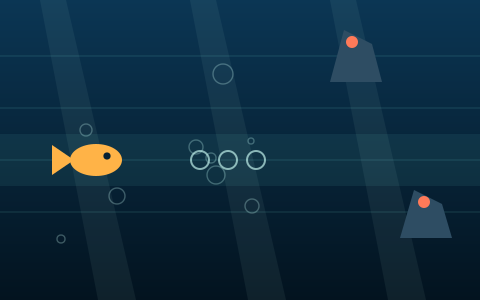
Four current lanes, rock spires in some and bubble strings in others. Switch lanes, keep the combo alive, keep going.
A side-scrolling navigation run. The canyon is generated from drifting target heights, so the passage shifts and tightens without ever becoming impossible. Speed steps up every 250 metres and energy cells are worth more at every tier.
Tip: turning your device to landscape gives this game a wider playfield.
Objective. Travel as far as possible through the canyon without touching a wall or a drifting boulder, collecting energy cells on the way.
The canyon scrolls past from right to left while the submarine holds station at roughly a quarter of the way across the stage. You only control vertical position — everything else is momentum. Thrust up or down, then stop, and the submarine keeps drifting for a moment; a very slight negative buoyancy means doing nothing at all makes you sink.
The canyon walls are generated one 14-pixel column at a time from two slowly drifting targets: a centre line and a gap width. Both move in small increments, so the passage snakes and pinches rather than jumping. The minimum gap shrinks with your speed tier but has a hard floor at 26% of the stage height, which means there is always room to get through.
Teal energy cells appear in clusters of one to three inside the passage, and free-floating boulders start appearing once you pass the 60-metre mark. Boulders sit off-centre inside the gap, so they narrow your route without ever blocking it entirely. Touching either wall or a boulder ends the run.
Every 250 metres the speed tier increases: the scroll rate rises by 16% of the base speed per tier, boulders spawn more often, and the canyon's minimum possible gap tightens. Energy cells are worth 15 points multiplied by the current tier, so late-run pickups are where the big scores come from.
| Input | Action |
|---|---|
| Up arrow / W | Thrust upward |
| Down arrow / S | Thrust downward |
| Hold left mouse button | Steer toward the pointer's height |
| P or Esc | Pause and resume |
| Space or Enter | Start or restart |
| Gesture | Action |
|---|---|
| Hold anywhere on the stage | The submarine moves toward your finger's height |
| Up / down touch buttons | Fixed-direction thrust, shown on touch devices |
| Tap Dive again | Restart after a crash |
Every game on this site also pauses with P or Esc, and pauses itself if you switch browser tabs mid-run. For a comparison of which input suits which game, see the underwater game controls guide.
Aim for the middle of the passage rather than reacting to whichever wall is closer. The canyon drifts smoothly, so a centred submarine almost never needs an emergency correction.
The passage centre can only move about 2.2 pixels per column, so the shape you see on the right edge of the screen is the shape you will fly through a second later. Read the far edge, not the near one.
A cell is 15 points. A crash costs the entire run. At tier 4 and above, a cell that requires crossing the passage is almost never worth it — distance alone is out-scoring it.
The submarine sinks on its own. For a descent, simply stop thrusting rather than pressing down — you keep far more control and you will not overshoot into the floor.
Every 250 m the gap floor tightens. If you are running wide when a new tier arrives, you will meet the narrowest passage of the run at the highest speed you have seen. Centre up as you approach each 250 m mark.
They spawn between 18% and 40% of the gap away from the centre line, which means the centre is usually clear. Another argument for flying the middle.
No. There are no weapons and nothing to shoot. The canyon and the boulders are the entire challenge, which is deliberate — this site keeps its submarine games focused on navigation rather than violence.
The gap floor stops shrinking at 26% of the stage height, so the canyon never becomes impossible. In practice the limit is concentration: the speed keeps rising and the margin for a late correction keeps shrinking.
The submarine's collision radius is slightly smaller than it looks, but its conning tower is drawn above the hull centre. If you clipped a ceiling, you were closer than the sprite suggested — fly the centre line.
No. They are pure score. Speed is driven entirely by distance travelled, so collecting or skipping cells does not change how fast the canyon comes at you.
Yes, and landscape is genuinely better here — a wider stage gives you more warning of the canyon ahead. The game re-sizes itself when you rotate.
Underwater Challenge Games
Four current lanes, rock spires in some and bubble strings in others. Switch lanes, keep the combo alive, keep going.
 Underwater Adventure Games
Pilot a submersible around an open water column, gather research samples and keep the hull intact before the survey clock runs out.
 Underwater Adventure Games
Follow the sonar through dark water to find each rescue marker before the clock runs out. The faster you find it, the more it is worth.
 Diving Games
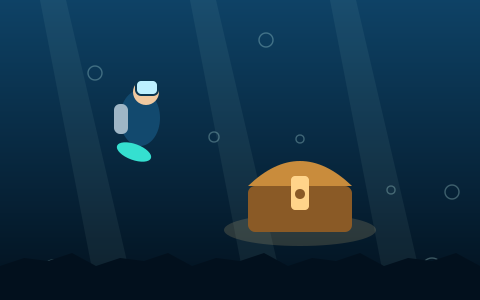
Dive for sunken chests, manage your air, and carry the haul back to the surface before it runs out — treasure only counts once it is banked.
 Diving Games
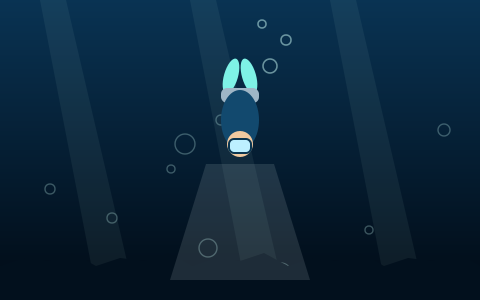
An endless descent. Steer past kelp and urchins, catch air pockets to keep breathing, and see how deep you can get.
 Ocean & Marine Games
Match pairs of reef creatures against a shared clock across boards that grow from eight cards to twenty-four.
 Underwater Challenge Games
Tap the glowing plankton before they fade, leave the jellyfish alone, and watch your accuracy as closely as your score.