Best Marine-Themed Games: Reefs, Fish and Sea Life
Not every ocean game is a race against a meter. The marine corner of the genre is about recognition, memory and pace.

Most of the underwater genre is about danger: hazards, depleting air, terrain trying to end your run. The marine corner is different. These are games about recognition — noticing a shape, remembering where it was, telling one thing from another quickly — and the pressure is cumulative rather than momentary.
They are also, not coincidentally, the most broadly playable games in the library. This piece covers what marine-themed games do well, why sea life happens to be excellent raw material for them, and which ones on this site are worth your time.
What a marine-themed game actually is
The label gets used for anything with a fish in it, which is not useful. A marine game in the sense meant here has three properties:
Sea creatures are the content, not the scenery. You interact with them directly — matching them, identifying them, reacting to them — rather than dodging them while doing something else.
The skill is perceptual. Recognition, memory, discrimination. Not momentum control, not resource management.
The pressure is cumulative. A clock over the whole session rather than a deadline on each individual action. You can think; you just cannot think forever.
That third property is what makes these games accessible. Nothing punishes you for pausing to consider, which removes the specific stress that puts many people off arcade games entirely.
Why sea life works so well as a symbol set
This is a genuinely interesting design accident. Recognition games need a symbol set with two properties that usually conflict: every symbol must be instantly distinguishable from every other, and none can be so detailed that it stops reading at small sizes.
Marine life is unusually good at both, because its structural variety is enormous.
Consider the twelve symbols used in Marine Match Challenge. A starfish is radially symmetrical. A seahorse is a vertical S. An anchor is bilaterally symmetrical with a crossbar. A jellyfish is a dome with trailing lines. A crab is horizontally wide with claws. A shell is a fan. A pearl is a plain circle. Not one of those reduces to the same silhouette as another, even at thirty pixels across on a phone.
Compare a set of twelve flowers, or twelve fruits, or twelve leaves — categories where half the members collapse into the same rough blob once you shrink them. Designers reach for sea life for matching games so often partly out of theme, and partly because it simply works.
Real animals, stylised shapes. The symbols in these games are generic category shapes — a crab outline, a turtle shell pattern — rather than depictions of particular species. Real marine biodiversity is vastly richer and stranger than any twelve-symbol set; the Smithsonian's ocean portal, linked at the foot of this page, is a properly sourced place to look at the real thing.
Marine Match Challenge
Marine Match Challenge is the clearest example on the site. A pair-matching memory game across boards growing from eight cards to twenty-four, with a shared clock that matches top back up.
Why it works: no individual action is timed. You can look at a board and think about it. The 70-second starting clock, topped up 2.2 seconds per match and 16 per board cleared (capped at 90), applies pressure to the session without applying it to any moment.
The scoring is the interesting part. Matches are worth 40 points plus 8 per level, multiplied by a combo that rises one step per two consecutive matches to x5. That means a match on level four at x5 is worth 360 points and the same match at x1 is worth 72 — so the entire score is decided by how long your streaks are, not how many pairs you find.
The counter-intuitive strategy: on each new board, turn cards over in reading order, deliberately accepting mismatches, and then clear the whole thing in one unbroken streak at x5. It feels like losing on purpose. It consistently out-scores cautious random clicking.
The accessibility detail worth noticing: every face-up card prints the name of its symbol underneath. Nothing about matching requires distinguishing colours, which is rare in this kind of game and entirely deliberate.
Underwater Obstacle Run
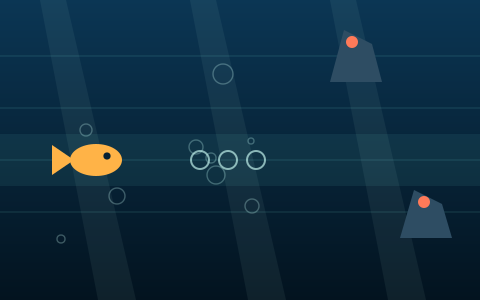
Underwater Obstacle Run is marine-themed in a lighter way: you play a stylised fish moving between four current lanes, dodging coral-topped rock spires and collecting bubble strings.
It is included here because it is the most approachable game on the site by a wide margin. Two controls, four seconds to understand, and comfortable one-handed in portrait on a phone — the only game here that genuinely is.
The marine content is doing less work than in Marine Match, but the design does something worth noting: the fish is drawn from primitives as a simple shape with a tail and an eye, not as a specific species. That is a deliberate choice rather than a limitation. A generic fish makes no claim about biology, whereas a recognisable clownfish or angelfish invites a player to assume the game knows something about how that animal behaves. It does not.
Deep Sea Explorer
Deep Sea Explorer is not a marine game in the strict sense — the skill is momentum control, not recognition — but it belongs in any discussion of how sea life is used well, because of its hazards.
Two hazard types drift through the water column: jellyfish and tumbling rocks. They are distinguished by movement as much as by shape. Jellyfish are slow, with long trailing tentacles extending well past the visible bell. Rocks are faster, tumble, and have a tight hitbox.
That difference is the useful part for a player: you learn to read behaviour rather than appearance. Jellyfish need more room than they look like they need; rocks need less. It is a small thing that makes the stage legible at a glance once you know it.
And to state the obvious: real jellyfish do not pursue submersibles. Their behaviour here is designed to create readable, avoidable danger, not to model anything.
Who these games suit
Anyone who finds arcade games stressful. The absence of per-action deadlines is the whole point. You are never punished for thinking.
Younger players. Nothing in this corner of the library is violent, nothing depicts injury, and Marine Match in particular is genuinely suitable for children. There is more on that in underwater games suitable for families.
Players who want something to improve at slowly. Recognition and memory improve on a longer curve than reaction speed. A reflex game plateaus in days; a memory game keeps getting better for weeks, because what improves is your search strategy rather than your hardware.
Anyone playing in short bursts. Matching games have natural stopping points at every board, which makes them easy to put down.
How to judge a marine game quickly
Are the symbols distinguishable by shape alone? Squint at the board. If two symbols are the same silhouette in different colours, the game will be frustrating for everyone and unplayable for some.
Is anything labelled? Text beside a symbol is a strong sign the designer thought about players who cannot rely on colour.
Is any single action timed? If cards flip back after a fixed delay, that is fine. If you must select within a countdown, the game has quietly become a reflex game.
Does the game claim biological accuracy? If a game describes a stylised sprite as a particular species and attributes behaviour to it, be sceptical. Arcade creature behaviour is designed around gameplay and says nothing about the real animal.
Key takeaways
- Marine games test recognition and memory rather than momentum or reflexes.
- Pressure is cumulative — a session clock, not a deadline on each action — which is what makes them accessible.
- Sea life is excellent symbol material because its structural variety keeps silhouettes distinct at small sizes.
- Marine Match Challenge is scored by streak length, so sweeping a board first and clearing it at x5 beats cautious clicking.
- Good marine games distinguish symbols by shape and label, not colour alone.
- Arcade creature behaviour is designed for gameplay and is not a depiction of real biology.
Frequently asked questions
What is a marine-themed game?
One where sea creatures are the content rather than the scenery — you match, identify or react to them directly — and where the skill tested is perceptual rather than physical. The pressure comes from a session clock rather than from deadlines on individual actions.
Are the creatures in these games based on real species?
They are generic stylised shapes — a crab outline, a turtle shell pattern, a jellyfish dome — rather than depictions of particular species, and their names in the games are category names. Their behaviour is designed for gameplay and tells you nothing about real animals.
Are marine games suitable for children?
Yes. Nothing in this part of the library is violent or depicts injury, there are no purchases or accounts, and Marine Match Challenge in particular has no per-action time pressure, which suits younger players well.
Why does the matching game print the name under each card?
So that matching never depends on distinguishing colours, and because a written name is easier to hold in memory than a small silhouette — especially on the twenty-four-card board. It is an accessibility measure that also happens to make the game better.
Do memory games get easier with practice?
Your search strategy improves considerably — sweeping a board systematically rather than clicking at random, and remembering names rather than pictures. Raw recall capacity changes much less, which is why technique matters more than talent in these games.
Where to go next
The ocean and marine games category collects these with fuller descriptions, and marine creature games goes deeper into how arcade design stylises sea life and where the line between stylisation and misinformation sits.
If the appeal is the low-pressure pacing rather than the theme, best casual ocean games approaches the same corner of the library from that angle.
References
- Smithsonian Ocean — Smithsonian National Museum of Natural History
Links open on the publisher's own site. Factual claims about real oceans, depths and marine life on this page are attributed to these sources; game mechanics described on this page come from the game code on this site.