 Underwater Challenge Games
Underwater Reflex
Tap the glowing plankton before they fade, leave the jellyfish alone, and watch your accuracy as closely as your score.
A memory game with an arcade clock. Twelve original marine symbols, each with a distinct silhouette and a printed name, so pairs never depend on colour alone. Matches buy time back, so a confident run keeps going.
Tip: turning your device to landscape gives this game a wider playfield.
Objective. Clear each board by matching every pair before the shared clock runs out. Consecutive matches raise a multiplier worth up to five times base points.
Cards start face down. Turn two over: if the symbols match they stay up and score, if they do not they flip back after three quarters of a second. The board grows with each level — 4x2, then 4x3, 4x4, 5x4 and 6x4, which is twenty-four cards and twelve pairs at the top size.
The clock is shared across every level rather than resetting. It starts at 70 seconds; each match returns 2.2 seconds and clearing a board returns 16, both capped at 90 seconds total. That cap is what stops a strong player from banking an unbeatable buffer.
The combo ladder rises one step for every two consecutive matches, to a maximum of x5. A single mismatch resets it. Base points per match are 40 plus 8 per level, so a x5 match on level four is worth 360 points against 72 at x1.
The twelve symbols — fish, starfish, shell, jellyfish, seahorse, crab, coral, turtle, urchin, anchor, pearl and kelp — are drawn from canvas primitives, each with a distinct outline, and every face-up card prints its name underneath. Nothing about matching requires distinguishing colours.
| Input | Action |
|---|---|
| Left click | Turn over the card under the pointer |
| Arrow keys or W A S D | Move the card cursor, wrapping at the edges |
| Space or Enter | Turn over the selected card |
| P or Esc | Pause and resume |
| Gesture | Action |
|---|---|
| Tap a card | Turn it over |
| On-screen D-pad | Move the cursor, if you prefer it to tapping |
Every game on this site also pauses with P or Esc, and pauses itself if you switch browser tabs mid-run. For a comparison of which input suits which game, see the underwater game controls guide.
On a new board, turn cards in reading order rather than at random. You will take a few mismatches, but you will know where everything is — and the combo you build afterwards more than repays it.
At x4 and x5 each match is worth three to five times base. When the multiplier is high, only turn a card you are confident about; when it has just reset, that is the moment to explore.
The printed name under each card is far easier to hold in memory than a small silhouette, especially on the 6x4 board. This is why the names are there.
Corner and edge positions are easier to recall spatially than the middle of a 24-card grid. Clearing them early shrinks the space you have to remember.
Arrow-key navigation wraps around the edges, so moving from the last column to the first is one keypress. On the 6x4 board this is genuinely faster than moving a mouse.
Time is capped at 90 seconds however well you play, so you cannot bank your way to an endless run. Past level four, speed matters more than accuracy.
No, it is a pair-matching memory game. You turn two cards at a time and look for identical symbols; there is no board-falling or chain-clearing mechanic.
Board sizes go up through five stages to 6x4, and then the 6x4 board repeats with rising point values. There is no ending — the clock decides.
Yes. Arrow keys move a visible cursor that wraps at the board edges, and Space or Enter turns over the selected card.
They are generic stylised shapes — a crab outline, a turtle shell pattern — not depictions of particular species, and their names are category names rather than species names.
The ladder advances one step per two consecutive matches, not per match. Two in a row gets you to x2, four to x3, and so on to x5.
Underwater Challenge Games
Tap the glowing plankton before they fade, leave the jellyfish alone, and watch your accuracy as closely as your score.
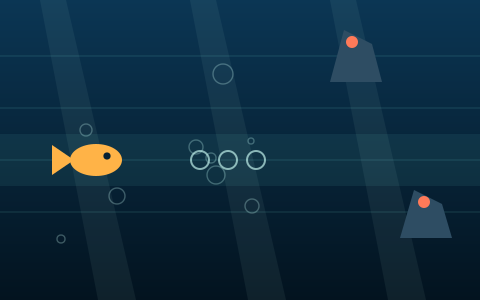 Underwater Challenge Games
Four current lanes, rock spires in some and bubble strings in others. Switch lanes, keep the combo alive, keep going.
 Underwater Adventure Games
Pilot a submersible around an open water column, gather research samples and keep the hull intact before the survey clock runs out.
 Submarine Games
Thread a submarine through a winding canyon that narrows as you go, collecting energy cells and pushing your distance record.
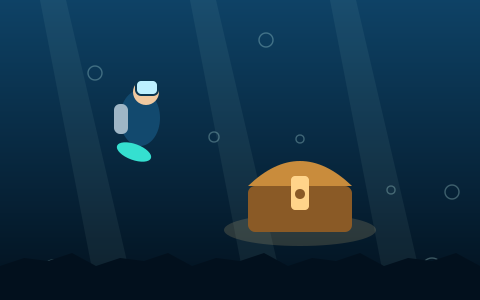 Diving Games
Dive for sunken chests, manage your air, and carry the haul back to the surface before it runs out — treasure only counts once it is banked.
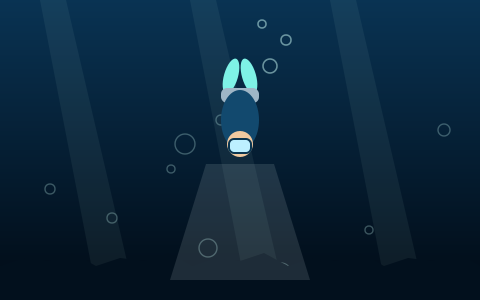 Diving Games
An endless descent. Steer past kelp and urchins, catch air pockets to keep breathing, and see how deep you can get.
 Underwater Adventure Games
Follow the sonar through dark water to find each rescue marker before the clock runs out. The faster you find it, the more it is worth.