Underwater Collection Games and How to Play Them Well
Collection games are travelling-salesman problems with a clock. Once you see that, your scores change.
Collection games look like the simplest thing in arcade design. Items appear, you go and get them, your score goes up. There is nothing to master.
Except that underneath, a collection game is a travelling-salesman problem with a clock attached — and once you see it that way, your scores change considerably. This article is about how collection games are actually built, why the naive strategy loses, and the routing habits that work.
Why "take the nearest thing" is wrong
The instinctive strategy is nearest-first: look at what is on screen, go to the closest item, repeat.
It fails for a reason that is easy to state and hard to feel while playing. Taking the nearest item optimises this trip and ignores what it does to the next one. If the closest sample is in the bottom-left corner, you end the trip in the bottom-left corner — which is the worst possible position for whatever appears next, because a corner has the highest expected distance to a random point on the field.
Nearest-first is a greedy algorithm, and greedy algorithms are known to produce poor routes for exactly this class of problem. The interesting part is that a very small amount of lookahead fixes most of it.
The one-step lookahead
The rule that works in practice:
Go to the nearest item that leaves you nearest the next one.
One step of lookahead, no more. Full route optimisation is not worth the cognitive cost in a game that ends in ninety seconds, and trying to plan four pickups ahead makes you slower at the one you are on.
In practice this means: when two items are roughly equidistant, take the one that points you at the cluster rather than away from it. When one item is slightly further but sits between you and two others, take that one.
It sounds marginal. Over a two-minute run with fifteen pickups it is the difference between an average score and a good one.
Holding the centre
The companion principle, and the more important of the two.
When you do not know where the next item will appear, wait near the middle of the playfield.
The reasoning is geometric: for a target equally likely anywhere on a rectangle, expected distance is minimised from the centre and maximised from a corner. On a typical stage, holding mid-field roughly halves your average travel to the next spawn.
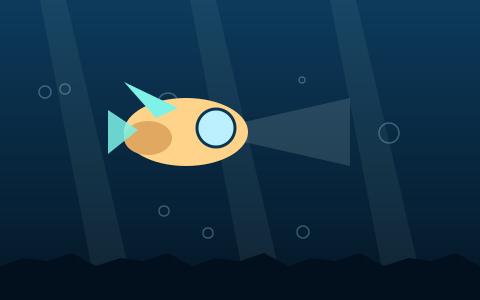
In Deep Sea Explorer, where research samples spawn continuously anywhere in the water column up to nine at a time, this alone is worth several samples per run.
The corollary is the part players skip: after collecting at the edge, drift back toward the middle rather than parking where you landed. Every second spent in a corner is a second of worse expected position.
Knowing the spawn model changes everything
Collection games use one of three spawn models, and the right strategy differs completely between them.
Continuous random spawning
Items appear at random positions on a timer, with a cap on how many exist at once. Deep Sea Explorer works this way: a new sample roughly every 0.7 to 1.5 seconds, up to nine on screen.
Strategy: hold the centre, take what comes, never chase. Since position is random, no amount of anticipation helps — only positioning does.
Placed-at-level-start
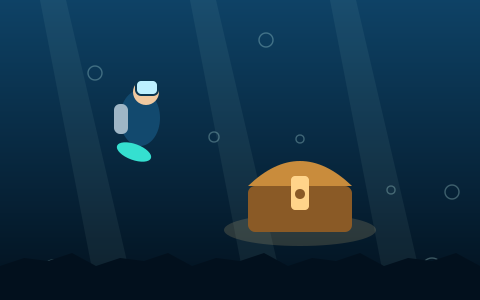
All items are placed when the level begins and nothing new appears. Ocean Treasure Hunt works this way: five plus one per level, distributed through the lower two thirds of the dive site.
Strategy: the opposite. Survey before moving. Because the full set is known and fixed, route planning has real value here — and because chests are worth more the deeper they are, the plan should usually be "deepest first, on the fullest air meter".
Spawned into a scrolling stream
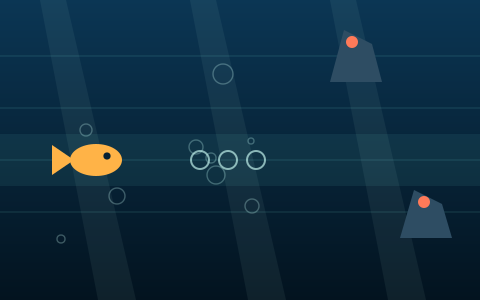
Items enter from one edge and leave from another. Underwater Obstacle Run and Deep Sea Diver both work this way.
Strategy: commit early. Everything is visible before it reaches you, and the decision is positional rather than navigational — pick your lane or your lateral position while the item is still far away, not when it arrives.
Expiring items beat valuable ones
A rule that overrides the routing advice above.
If an item disappears on a timer, it is worth more than its face value, because it is the only item you can actually lose. Everything else will wait.
The clearest example is the gold beacon in Deep Sea Explorer: 60 points plus eight seconds of survey clock, alive for nine seconds. Eight seconds of clock is worth roughly six ordinary samples in collection time, and it will be gone.
New players ignore beacons because nearer samples are closer. That is the single most expensive routing error available in that game, and it is entirely a failure to price expiry correctly.
When collecting has a cost
The most interesting collection games charge you for carrying.
Ocean Treasure Hunt gives you a three-item carry limit and a 13% speed penalty per item, and nothing scores until you return it to the surface. That changes the problem from "which items" to "which set of items, and can I afford the trip home with them".
Two consequences:
The optimal load is usually below the maximum. Two chests beats three in most situations, because the third penalty applies to the longest and most expensive part of the journey, and because failure costs the whole set rather than one item.
Route planning has to include the return. Plan the ascent before the descent. Improvising a third pickup while already slow and heavy at maximum depth is how the majority of runs end.
Three drills
The centre drill. One run of Deep Sea Explorer where after every pickup you deliberately drift toward the middle before choosing the next target. Compare your sample count to a normal run.
The narration drill. Say your next target out loud while travelling to the current one. Speaking it forces the decision early, which eliminates the second of hovering that happens on every pickup.
The two-chest drill. Ten runs of Ocean Treasure Hunt carrying no more than two chests. Compare the average against your previous ten. Most players find the two-chest average higher.
Key takeaways
- A collection game is a routing problem with a clock, not a reaction test.
- Nearest-first is a greedy strategy and produces poor routes; one step of lookahead fixes most of it.
- Hold the centre when spawns are random — it roughly halves average travel distance.
- Strategy depends on the spawn model: random, placed-at-start, or scrolling stream.
- Expiring items outrank valuable ones because they are the only ones you can lose.
- When carrying has a cost, the optimal load is usually below the maximum.
Frequently asked questions
What is the best strategy in an underwater collection game?
Hold the centre of the playfield when you do not know where the next item will appear, and use a one-step lookahead when choosing between items — take the nearest one that leaves you closest to the next. Always take expiring items first.
Why is taking the nearest item a bad idea?
Because it optimises the current trip and ignores where it leaves you. Collecting an item in a corner puts you in the corner, which has the highest expected distance to whatever appears next. A small amount of lookahead avoids most of the cost.
Should I always collect the maximum I can carry?
Usually not. When carrying has a movement penalty, the last item applies that penalty to the entire journey home — the longest and most expensive part — and over-reaching costs the whole load rather than one item.
Does it matter where items spawn from?
Enormously. Randomly spawning items reward positioning and punish chasing. Items placed at level start reward surveying and planning. Items entering a scrolling stream reward committing early, because everything is visible before it arrives.
Are collection games easier than reaction games?
They are more forgiving — a bad decision costs points rather than the run — but scoring well requires routing judgement that develops more slowly than reaction speed. The skill ceiling is higher and further away.
Where to go next
The exploration strategy guide covers search patterns and positioning in more depth, with drills. For the version of this problem where carrying costs you, underwater treasure games and the risk–reward loop.
And for practice technique generally, how to improve your skills in underwater arcade games.