The Best Underwater Arcade Games to Play Online Free
Eight underwater arcade games, played properly and ranked by what they ask of you rather than by how they look in a screenshot.

There are eight underwater arcade games on this site. All of them are free, all run in a browser, and all were written for underwaterarcade.xyz rather than licensed or embedded from somewhere else. That last point matters for a ranking like this one: I can tell you exactly what each game is doing, because I can read the code that does it.
What follows is ordered by something more useful than "which is best" — a question nobody can answer for you. It is ordered by what each game demands of you, from the most approachable to the most punishing, with an honest note about who each one suits and who should skip it.
How this list is ordered
Three things decide a game's position here.
Time to first competent run. How long before a new player stops fighting the interface and starts making real decisions. In the best games here that is under a minute; in the hardest it is closer to twenty.
What the skill actually is. Reading terrain, managing a resource, remembering positions, or raw reaction speed. These are genuinely different abilities and people are genuinely better at some than others.
Whether the second run is inevitable. The hardest quality to fake and the one that decides whether a game is worth publishing at all.
Nothing here is scored out of ten, and no user ratings are collected on this site, so no star ratings appear. The ordering is one editor's judgement after playing each game far more than was necessary to describe it.
1. Underwater Obstacle Run — the best starting point
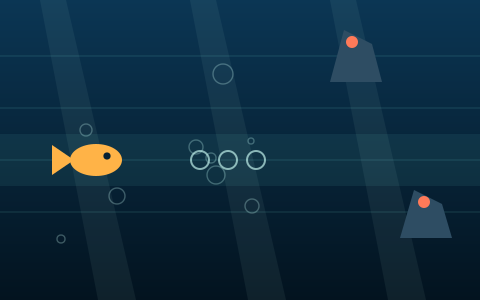
Underwater Obstacle Run does one thing and does it cleanly. Four horizontal current lanes scroll past; some contain rock spires, others contain strings of bubbles. You change lanes. That is the entire control scheme.
What makes it the best entry point is that the generator always leaves at least one lane open. There is no such thing as an unavoidable wave, so every death is legibly your own fault, which is exactly the property that makes a player press restart instead of closing the tab.
The depth comes from the scoring. Distance is tracked but contributes nothing — the score is bubbles multiplied by a combo that climbs to x8 and collapses the moment you miss a bubble string. So the game you are playing at minute three ("survive") is not the game you are playing at minute thirty ("never break the streak"), and that transition happens without a tutorial.
Play it if you want something you can hold in one hand on a phone. It is the only game here that is genuinely comfortable one-handed in portrait.
Skip it if you want spatial freedom. This is a rail, and it is honest about that.
2. Marine Match Challenge — the one with no reflex tax
Marine Match Challenge is a pair-matching memory game across boards that grow from eight cards to twenty-four, with a shared clock that matches top back up.
It earns second place because it is the only game on the site where no individual action is timed. You can think. The pressure comes from the overall clock rather than from any moment, which makes it the right choice for anyone who finds arcade games stressful rather than fun, and the right choice for younger players.
The design detail worth noticing: twelve marine symbols, each with a genuinely distinct silhouette — a radial starfish, a vertical seahorse, a domed jellyfish, a symmetrical anchor — and every face-up card prints its name underneath. Nothing about matching requires distinguishing colours, which is unusual in this kind of game and entirely deliberate.
Play it if you want to think rather than react, or you are looking for something a child can play.
Skip it if memory games bore you. No amount of good design fixes that.
3. Deep Sea Explorer — the best introduction to the physics
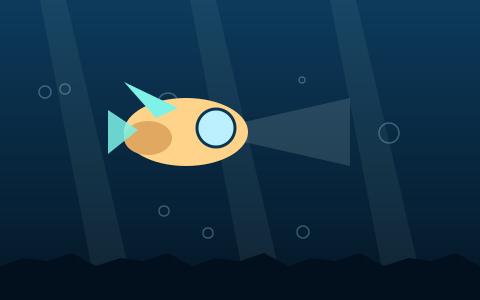
Deep Sea Explorer is where the library's handling model shows up for the first time. You pilot a small submersible around an open water column, collecting research samples before a survey clock expires, avoiding drifting jellyfish and rocks.
The submersible accelerates rather than moving. Water drag slows it. A slight negative buoyancy pulls it downward whenever you stop steering. Five minutes with this game teaches you a control model that four other games on the site reuse, and it teaches it in an open arena where a mistake costs one of three hull segments rather than the whole run.
The best thing in it is the gold beacon: worth 60 points and eight seconds of clock, alive for only nine seconds. It is almost always worth crossing the entire stage for, and recognising that is the first genuinely strategic decision the library asks you to make.
Play it if you want the most relaxed thing here that still has real depth, or if you intend to play any of the other physics-based games.
Skip it if you want something with a hard edge. It is forgiving by design.
4. Ocean Rescue Challenge — the quiet one
Ocean Rescue Challenge is a search-and-recovery game played in the dark. Your dive light illuminates a circle around your ROV and nothing else, and it shrinks every round — from roughly 150 pixels down to a floor of 80.
That sounds hostile and it is not. There is nothing in this game that can hurt you. Drifting debris costs 2.5 seconds if you bump it, and the clock is the only opponent. What the darkness does is force you to navigate by instrument: a bearing arrow that always points at the marker, a ping ring that tightens as you close in, and a numeric distance read-out.
It is the most distinctive game in the library because of that shift. By round six you will reach the marker before you can see it, and learning to trust the arrow over your own eyes is a genuinely satisfying moment.
Play it if you want something calm that still has a clock.
Skip it if limited visibility frustrates you. Some people find it claustrophobic rather than atmospheric, and that is a reasonable reaction.
5. Ocean Treasure Hunt — the one with the real decision
Ocean Treasure Hunt asks the single best question in the library, repeatedly: one more chest, or turn back now?
The setup makes that question genuinely hard. The dive site is two and a half screens deep. Chests are worth more the deeper they are. You can carry three, and each one makes you about 13% slower. Oxygen drains between 3.4% and 8.6% per second depending on depth. And nothing scores until you carry it back above the surface line — drown with a full load and you bank nothing at all.
Every one of those numbers exists to make greed expensive. It works. Most players over-reach for a third chest, lose all three, and understand the game immediately afterwards.
Play it if you like games where the interesting part is the decision rather than the execution.
Skip it if losing accumulated progress annoys you. That is the entire mechanic, and it will happen.
6. Deep Sea Diver — the endless one
Deep Sea Diver is an endless descent with one failure condition: oxygen reaching zero. Nothing collides fatally, nothing injures you, there is no bottom.
Its difficulty curve is the most interesting on the site because it is a supply problem rather than a reflex problem. Air pockets restore 26% of your oxygen, and their frequency drops from about 42% of spawned items down to a floor of 14% as you descend, while the drain rate rises and the descent accelerates. Around 400 metres the supply curve crosses the demand curve and you simply cannot afford to collect pearls any more.
That moment — where the correct play changes from "collect everything" to "ignore the points entirely" — is the game.
Play it if you like chasing a single number with no ceiling.
Skip it if endless games feel pointless to you. There is no ending here and there is not meant to be.
7. Submarine Adventure — the hardest to learn, best to master
Submarine Adventure will end your first four runs quickly and unhelpfully, and then become the best game here.
You thread a submarine through a canyon generated one column at a time from two drifting targets. It is deliberately non-violent — no weapons, nothing to shoot — because the terrain is already a complete opponent.
The reason it frustrates new players is that the correct technique is not discoverable by instinct. You must watch the right-hand edge of the stage rather than your submarine, and you must fly the centre of the passage rather than reacting to whichever wall is closer. Both feel wrong. Both roughly triple the distance of a typical run once they become automatic. The navigation guide exists largely because of this.
Play it if you are willing to be bad at something for fifteen minutes.
Skip it if you are not. Nothing wrong with that.
8. Underwater Reflex — the specialist
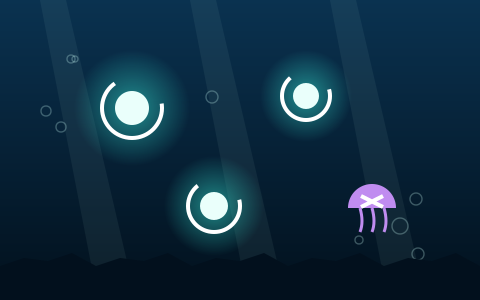
Underwater Reflex is last not because it is worst but because it is the least broadly enjoyable. It is a pure reaction test with a decision layer: tap glowing plankton before they fade, leave the marked jellyfish alone, three misses and you are out.
Points scale with how fast you react — 200 for an instant tap, falling by 150 per second to a floor of 30 — while the fade window shrinks from 1.85 seconds toward 0.62. Two players with identical hit counts can score four times differently.
It is genuinely excellent at what it does, and what it does will not appeal to everyone. It is also the only game here that tracks accuracy as a separate personal best, which gives players who prefer judgement to speed something of their own to chase.
Play it if you enjoy measuring yourself against a number.
Skip it if you are new to the genre. Come back to it last.
Which one should you actually open?
If you have five minutes: Underwater Obstacle Run.
If you want to relax: Marine Match Challenge or Ocean Rescue Challenge.
If you want to get good at something: Submarine Adventure.
If you want one interesting decision repeated: Ocean Treasure Hunt.
If you are on a phone in portrait: Underwater Obstacle Run, again.
And if you would rather not choose, the game library has a random button.
Key takeaways
- All eight games are free, browser-based, original to this site, and need no account.
- Underwater Obstacle Run is the best entry point — two controls and no unavoidable deaths.
- Deep Sea Explorer teaches the momentum model that four other games reuse.
- Ocean Treasure Hunt has the library's best single decision: turn back, or take one more.
- Submarine Adventure is the hardest to learn and the most rewarding to master.
- Underwater Reflex is excellent but narrow — play it last, not first.
Frequently asked questions
Are all of these underwater games really free?
Yes. Every game on this site is free with no account, no download, no in-game purchases and no premium tier. Scores are saved in your own browser's local storage rather than on a server.
Which underwater arcade game is best for beginners?
Underwater Obstacle Run. It has two controls, no momentum to manage, and a wave generator that always leaves at least one lane open, so a new player can build the habit of looking ahead without anything else competing for attention.
Do these games work on phones?
All of them do. Underwater Obstacle Run, Deep Sea Explorer and Ocean Rescue Challenge are the strongest on a small screen. Submarine Adventure is playable but genuinely better in landscape, because a narrow stage gives less warning of the canyon ahead.
Why are there no star ratings in this ranking?
Because this site collects no user ratings, so publishing a score out of five would be inventing a signal that does not exist. The ordering here is one editor's judgement, explained in the opening section, rather than an aggregate of anything.
Are these games hosted from elsewhere?
No. All eight were written specifically for this site in HTML5, canvas and plain JavaScript. Nothing is embedded from a third-party portal, which is why the guides on this site can quote exact spawn rates and multiplier caps.
How long does a typical run last?
Two to five minutes in most of them. Deep Sea Explorer starts with 75 seconds and extends with pickups; Ocean Rescue Challenge starts at 55 seconds; the endless games last as long as you survive. None of them require a long sitting.
The short version
Eight games, no accounts, no downloads, and a genuine spread of what they ask of you. Start with Underwater Obstacle Run, spend fifteen minutes in Deep Sea Explorer learning the momentum model, and then follow whichever direction appeals — the beginner's guide suggests an order for the whole library if you would rather be told.
When you want to stop surviving and start scoring, the high score guide breaks down where the points actually are in each game, which is a different question from which game is good.