 Ocean & Marine Games
Marine Match Challenge
Match pairs of reef creatures against a shared clock across boards that grow from eight cards to twenty-four.
A reaction test with a decision layer. Points scale with how fast you react, so identical hit counts can score wildly differently — and from round two onward, jellyfish share the water and must be left alone.
Tip: turning your device to landscape gives this game a wider playfield.
Objective. Tap every glowing plankton before it fades, avoid the marked jellyfish, and keep your reaction times short. Three missed plankton ends the run.
Glowing teal plankton surface at random points and fade out on a timer shown as a ring around each one. Tapping one scores; letting one fade is a miss. Three misses ends the run.
Points are entirely reaction-based: 200 points for an instant tap, falling by 150 per second of delay, with a floor of 30. Because the fade window also shrinks — from 1.85 seconds at the start to a floor of 0.62 — the same tap gets worth less and harder at the same time.
From round two, jellyfish drift in alongside the plankton, marked with a white cross so they are identified by symbol rather than colour. Tapping one costs 40 points and resets your combo. They get more common as rounds progress, up to about 38% of spawns, which is what turns the game from a click test into a decision test.
The combo multiplier rises one step per four consecutive hits, to a maximum of x5. Tapping open water costs nothing at all — only real mistakes are penalised.
Two control schemes are equally supported: pointer and touch, or an arrow-key reticle with Space to tap. The reticle appears automatically as soon as you use a direction key.
| Input | Action |
|---|---|
| Left click | Tap wherever the pointer is |
| Arrow keys or W A S D | Move the aiming reticle |
| Space or Enter | Tap at the reticle |
| P or Esc | Pause and resume |
| Gesture | Action |
|---|---|
| Tap the screen | Tap that point |
| On-screen D-pad plus action | Move the reticle and tap, if you prefer |
Every game on this site also pauses with P or Esc, and pauses itself if you switch browser tabs mid-run. For a comparison of which input suits which game, see the underwater game controls guide.
Targets appear anywhere. Returning to the centre between taps minimises your average travel distance, which matters more than raw clicking speed once the fade window drops below a second.
Every jellyfish carries a white cross. At speed it is the cross, not the colour or the shape, that your eye can catch in time.
When two plankton are up, the one with the emptier ring is about to expire. Taking the fresher one first often converts a double into a hit plus a miss.
Tapping nothing costs no points and no accuracy. If you are unsure whether you can reach a target, going for it is always better than hesitating.
Score rewards speed, accuracy rewards judgement, and they are stored independently. A deliberate, slower run can set an accuracy best while scoring modestly.
Arrow-key aiming moves at a fixed 520 pixels per second, which is competitive on a small stage — and it never overshoots the way a mouse does.
Each plankton is worth 200 points minus 150 per second of reaction time, with a minimum of 30, multiplied by your current combo multiplier. Average reaction time in milliseconds is shown in the end-of-run summary.
You lose 40 points and your combo resets to x1. It does not end the run and it does not count as one of your three misses — but it does count against accuracy.
Yes, fully. Arrow keys move an aiming reticle and Space taps. The reticle appears the moment you press a direction key.
The fade window shrinks toward 0.62 seconds and jellyfish reach nearly 40% of spawns, so you are both reacting faster and deciding more often. Keeping the pointer centred helps more than anything else.
No. This measures the time from a target appearing to you tapping it, including target acquisition and pointer travel, so the numbers run well above a laboratory simple-reaction measurement. Treat it as a game score, not a clinical result.
Ocean & Marine Games
Match pairs of reef creatures against a shared clock across boards that grow from eight cards to twenty-four.
 Underwater Challenge Games
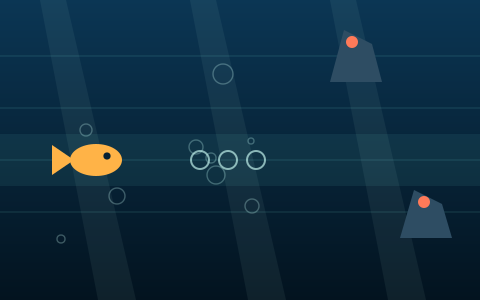
Four current lanes, rock spires in some and bubble strings in others. Switch lanes, keep the combo alive, keep going.
 Underwater Adventure Games
Follow the sonar through dark water to find each rescue marker before the clock runs out. The faster you find it, the more it is worth.
 Underwater Adventure Games
Pilot a submersible around an open water column, gather research samples and keep the hull intact before the survey clock runs out.
 Submarine Games
Thread a submarine through a winding canyon that narrows as you go, collecting energy cells and pushing your distance record.
 Diving Games
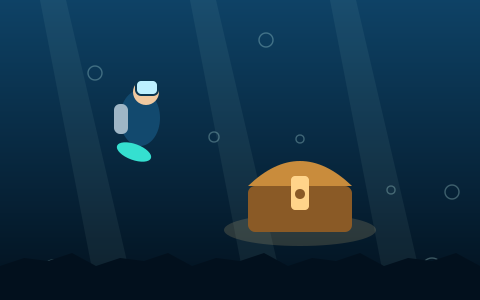
Dive for sunken chests, manage your air, and carry the haul back to the surface before it runs out — treasure only counts once it is banked.
 Diving Games
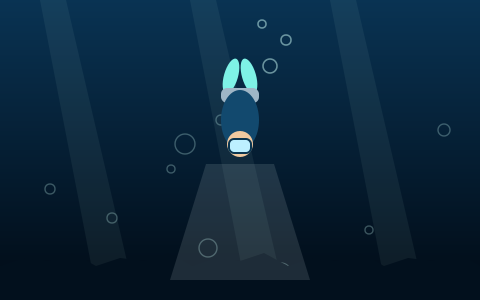
An endless descent. Steer past kelp and urchins, catch air pockets to keep breathing, and see how deep you can get.