Best Underwater Skill and Reflex Games
Reflex games are easy to design badly. These get the two things right that matter: a visible deadline and a penalty worth avoiding.

Reflex games are easy to make and hard to make well. Put targets on a screen, take them away after a while, count the hits — the mechanic writes itself. What separates a good one from a stopwatch with graphics is whether it is measuring anything worth measuring.
This piece covers what a reflex score actually represents, the two properties that make a reaction game fair, why a decision layer matters more than raw speed, and the underwater skill games worth your time.
What a reflex score actually measures
Not your reaction time. This is worth stating clearly because the numbers look like they should be comparable to a laboratory measurement, and they are not remotely.
A clinical simple-reaction test measures the interval between a single, predictable stimulus and a single, pre-prepared response — usually one button, already under your finger. Healthy adult figures typically land somewhere in the low hundreds of milliseconds.
A game like Underwater Reflex measures something substantially larger. Between the target appearing and you tapping it, you have to:
- Notice that something appeared, anywhere on a stage.
- Locate it spatially.
- Decide whether it is a target or a decoy.
- Move a pointer or a finger there.
- Commit.
Steps two and four are the big ones, and both scale with distance. Your "reaction time" in a reflex game is mostly a measure of target acquisition and travel, which is why the single most effective technique is returning your pointer to the centre between taps — it minimises average travel, and it does more for your score than reacting faster ever will.
Treat the number as a game score. It is a perfectly good one; it just is not a clinical result.
Two properties that make a reaction game fair
1. A visible deadline
The player must be able to see how long each target has left. Without it, a target vanishing feels arbitrary — you cannot prioritise, and you cannot learn.
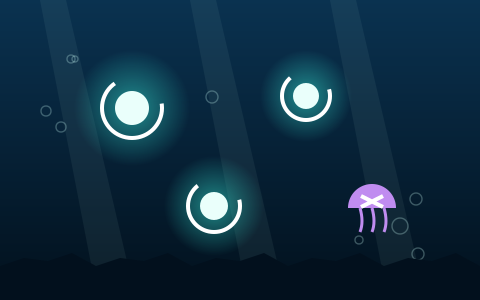
Underwater Reflex draws a countdown ring around each plankton that depletes as its window closes. That single UI element converts the game from "tap things fast" into "decide which thing to tap first", because when two targets are up you can see which is about to expire.
The correct play follows immediately: take the oldest target first. Taking the fresher one converts a double into a hit plus a miss.
2. A generous hit radius
A reflex game should test reaction, not precision. If the hit area matches the sprite exactly, you are also testing fine motor control, which is a different skill and one that punishes touch players disproportionately.
Underwater Reflex uses a hit radius 145% of the visible target. That is deliberately loose, and it is what makes the game playable with a thumb without changing the difficulty for anyone.
If a reaction game feels unfair on a phone, this is almost always why.
Why the decision layer matters more than speed
A pure reaction test gets boring quickly, because there is only one correct action and you either performed it fast enough or you did not. There is no strategy, only throughput.
Adding something you must not hit changes the game entirely. Now every target requires a classification before a response, and classification takes time you do not have.
Underwater Reflex introduces jellyfish from round two, rising to nearly 40% of spawns. They cost 40 points and reset your combo. Crucially, they are marked with a white cross — a symbol, not just a colour — because at speed the eye can catch a high-contrast shape faster than it can judge a hue, and because colour alone is not a reliable signal for every player.
The result is that the game rewards a specific, learnable discipline: check the cross before committing. That is a skill rather than a reflex, and it is why the game stays interesting past the first twenty runs.
How reaction scoring should work
The scoring formula in Underwater Reflex is worth showing because it explains all the strategy:
points = max(30, 200 − reaction seconds × 150) × multiplier
An instant tap is 200. A one-second tap is 50. A tap right at the fade is the floor of 30. The multiplier rises one step per four consecutive hits to a maximum of x5.
Two design decisions inside that formula matter.
The floor. A slow hit is still worth something. Without a floor, late taps would be worthless and the rational play would be to ignore anything you could not reach instantly — which makes the game less active, not more.
The steep decay. At 150 points per second, hesitation is the expensive mistake. Two players with identical hit counts can score four times differently, which is what makes the number meaningful.
The corollary is that tapping empty water costs nothing: no points, no accuracy penalty. So there is never a reason to hold back when unsure whether you can reach something. Going for it is always correct.
Accuracy as a separate number
A detail worth singling out: Underwater Reflex tracks accuracy — hits against missed plankton and mistaken jellyfish taps — as its own personal best, independent of score.
That matters because score and accuracy reward opposite temperaments. Score rewards speed and commitment; accuracy rewards judgement and restraint. Collapsing them into one number would force every player toward the same style.
Keeping them separate means a deliberate, careful player can set an accuracy record while scoring modestly, and that is a legitimate way to be good at the game.
The other skill games worth playing
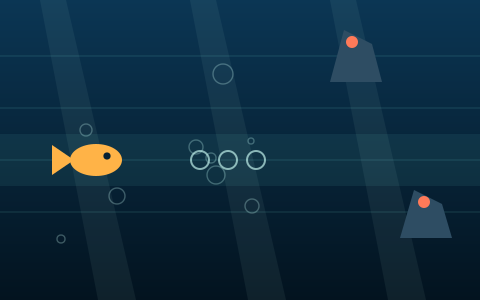
Underwater Obstacle Run is a reaction game with the precision removed entirely — you only ever change lanes, so nothing is ever a question of aim. What it tests is decision speed under a scrolling deadline, which is a cleaner version of the same ability. It is also the most forgiving place to practise it, because at least one of four lanes is always open.
Marine Match Challenge is the opposite corner: a skill game with no reaction component at all. No individual action is timed. What it tests is recall and search strategy, and it is the right recommendation for anyone who wants to compete against a number without the physical demand.
Ocean Rescue Challenge sits in between — a speed bonus decaying at 14 points per second makes directness matter, but the pressure is on your route rather than your hands.
How to actually get better
Return to the centre between taps. The single highest-value habit. Once the fade window drops below a second, average travel distance dominates everything else.
Take the oldest target first. Read the countdown rings. When two are up, the emptier ring is about to expire.
Check the symbol, not the colour. Train yourself on the white cross. It is the fastest discriminator available and the only one that works reliably at speed.
Never hesitate. Empty water is free. Hesitation costs 150 points a second.
Protect a high multiplier. At x5, a mistaken jellyfish tap costs far more than its 40 points — it costs the multiplier that was making every hit worth five times as much.
Key takeaways
- A game reflex score measures target acquisition and travel, not clinical reaction time.
- Fair reaction games need a visible deadline per target and a generous hit radius.
- A decision layer — something you must not hit — is what keeps a reflex game interesting.
- Decoys should be marked by symbol, not colour alone.
- Scoring should decay steeply but have a floor, so late hits still count.
- Keep your pointer centred, take the oldest target first, and never hesitate — empty water is free.
Frequently asked questions
Is my score in a reflex game a real measure of my reaction time?
No. It includes noticing the target, locating it, classifying it and physically moving your pointer or finger there, which makes the numbers run well above a laboratory simple-reaction measurement. It is a game score, not a clinical result.
How do I improve at underwater reflex games?
Return your pointer to the centre between taps — average travel distance matters more than raw speed once the target window drops below a second. Then take the oldest target first, read symbols rather than colours, and never hesitate, since tapping empty water costs nothing.
Why are some targets ones I should not tap?
Because a pure reaction test has no strategy — there is one correct action and only throughput to optimise. Adding something you must classify before responding turns it into a decision game, which is what keeps it interesting past the first twenty runs.
Are reflex games playable on a phone?
Yes, provided the hit radius is generous. Underwater Reflex uses 145% of the visible target for exactly that reason. The remaining mobile problem is thumb occlusion — targets can spawn under your own hand — which is best solved by resting at the screen edge and reaching in.
Can I play a reflex game with a keyboard?
In Underwater Reflex, yes. Arrow keys move an aiming reticle at a fixed 520 pixels per second and Space taps. It is more competitive than it looks, because a reticle never overshoots the way a mouse does.
Why is accuracy tracked separately from score?
Because the two reward opposite temperaments — score rewards speed and commitment, accuracy rewards judgement and restraint. Keeping them separate lets a careful player set a record without being forced into a style that does not suit them.
Where to go next
The challenge games category collects the skill games, and the high score guide covers the scoring formulas in detail.
For the mechanics behind reaction scoring specifically, read underwater reaction games and how reaction scoring works, and for practice technique, how to improve your skills.