 Underwater Adventure GamesFeatured
Deep Sea Explorer
Pilot a submersible around an open water column, gather research samples and keep the hull intact before the survey clock runs out.
Dive into fun underwater arcade games, ocean adventures, submarine challenges, diving games and marine-themed browser experiences.

Hand-picked starting points across the five playable categories.
Underwater Adventure GamesFeatured
Pilot a submersible around an open water column, gather research samples and keep the hull intact before the survey clock runs out.
Submarine GamesFeatured
Thread a submarine through a winding canyon that narrows as you go, collecting energy cells and pushing your distance record.
 Diving GamesFeatured
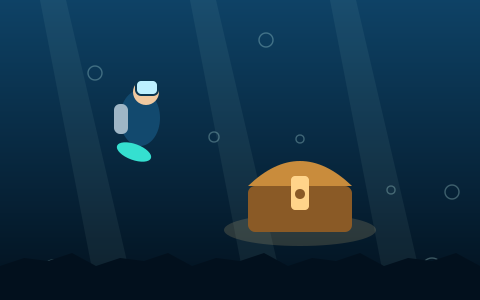
Dive for sunken chests, manage your air, and carry the haul back to the surface before it runs out — treasure only counts once it is banked.
 Underwater Challenge GamesFeatured
Four current lanes, rock spires in some and bubble strings in others. Switch lanes, keep the combo alive, keep going.
 Ocean & Marine GamesFeatured
Match pairs of reef creatures against a shared clock across boards that grow from eight cards to twenty-four.
Loading today's featured game…
Picked up from this browser only. Nothing is stored on a server.
Open-water exploration games where the playfield is somewhere to travel through rather than a single screen to survive. Expect free movement, objectiv…
2 gamesPiloting games built around momentum and tight passages. These are navigation challenges rather than combat games — the terrain is the opponent, and r…
1 gamesGames where the air gauge is the clock. Every diving game here asks the same question in a different shape: how much further can you go before you hav…
2 gamesThe calmer end of the library. Reef environments, stylised sea creatures and games that reward attention rather than reaction speed — a good starting …
1 gamesShort-session games with a single number at the end. Endless runs, timed objectives and reaction tests — the part of the library built for beating you…
2 gamesWritten walkthroughs and technique notes for the games on this site. Each guide is built from actual play, not from a specification sheet — the number…
8 guidesOrdered by how often visitors open each game page.
Underwater Adventure Games
Pilot a submersible around an open water column, gather research samples and keep the hull intact before the survey clock runs out.
Submarine Games
Thread a submarine through a winding canyon that narrows as you go, collecting energy cells and pushing your distance record.
Diving Games
Dive for sunken chests, manage your air, and carry the haul back to the surface before it runs out — treasure only counts once it is banked.
Underwater Challenge Games
Four current lanes, rock spires in some and bubble strings in others. Switch lanes, keep the combo alive, keep going.
The most recently published games on the site.
 Underwater Challenge GamesNew
Tap the glowing plankton before they fade, leave the jellyfish alone, and watch your accuracy as closely as your score.
Ocean & Marine GamesNew
Match pairs of reef creatures against a shared clock across boards that grow from eight cards to twenty-four.
 Underwater Adventure GamesNew
Follow the sonar through dark water to find each rescue marker before the clock runs out. The faster you find it, the more it is worth.
Underwater Challenge GamesNew
Four current lanes, rock spires in some and bubble strings in others. Switch lanes, keep the combo alive, keep going.
Open-water exploration games where the playfield is somewhere to travel through rather than a single screen to survive. Expect free movement, objectives spread across a map, and a reason to go deeper.
Underwater Adventure Games
Pilot a submersible around an open water column, gather research samples and keep the hull intact before the survey clock runs out.
Underwater Adventure Games
Follow the sonar through dark water to find each rescue marker before the clock runs out. The faster you find it, the more it is worth.
Piloting games built around momentum and tight passages. These are navigation challenges rather than combat games — the terrain is the opponent, and reading it early is the whole skill.
Submarine Games
Thread a submarine through a winding canyon that narrows as you go, collecting energy cells and pushing your distance record.
Games where the air gauge is the clock. Every diving game here asks the same question in a different shape: how much further can you go before you have to turn back?
Diving Games
Dive for sunken chests, manage your air, and carry the haul back to the surface before it runs out — treasure only counts once it is banked.
 Diving Games
An endless descent. Steer past kelp and urchins, catch air pockets to keep breathing, and see how deep you can get.
The calmer end of the library. Reef environments, stylised sea creatures and games that reward attention rather than reaction speed — a good starting point if fast arcade games are not your thing.
Ocean & Marine Games
Match pairs of reef creatures against a shared clock across boards that grow from eight cards to twenty-four.
Short-session games with a single number at the end. Endless runs, timed objectives and reaction tests — the part of the library built for beating your own best rather than finishing anything.
Underwater Challenge Games
Four current lanes, rock spires in some and bubble strings in others. Switch lanes, keep the combo alive, keep going.
Underwater Challenge Games
Tap the glowing plankton before they fade, leave the jellyfish alone, and watch your accuracy as closely as your score.
Sometimes yes, usually by accident. What actually determines whether a browser game still runs on a plane.
Every treasure game is one decision repeated: one more chest, or turn back? Here is how to answer it correctly.
Every wave, bubble and submarine on this site is a few dozen lines of drawing instructions. Here is how that works.
Five things a small arcade game can do for accessibility without a budget, and how to check whether a game you are about to play does them.
Four dials, turned in different combinations, produce every difficulty curve in the genre. Here they are with the numbers attached.
Your best score lives in your own browser, not on a server. What that gets you, and the three ways it disappears.
Which games actually work one-handed, when to rotate, and the settings that stop a phone throttling mid-run.
Scoring systems game by game, which ones reward risk, and the four habits that move a score more than raw skill does.
Four search patterns, when each one is right, and why holding the centre beats sweeping the edges in almost every open-water game.
An underwater setting gives an arcade game something most themes cannot: a reason for everything to move the way it does. Water drag explains why a submersible coasts instead of stopping. Buoyancy explains why standing still is not an option. An air supply explains why the clock exists at all. The theme is doing mechanical work, not just decorating a scoreboard.
It also gives the genre its best single idea — depth. Depth is simultaneously a score, a difficulty setting and a threat, which is a rare thing to get from one number. Going deeper is always more valuable and always more dangerous, so the game never has to explain why you should take a risk.
The practical case is simpler. These games load in a second or two, explain themselves on the first screen and finish in three to five minutes. There is no installer, no account, no launcher and no patch. They run on a six-year-old phone because they are drawing vector shapes, not streaming textures.
And because every game here is written specifically for this site, the guides can quote the actual numbers: how much oxygen a pickup restores, how wide the canyon gets at tier five, where a combo multiplier caps. That is the difference between a tips page and a guide.
Short answers to the questions new visitors ask most often.
Underwater arcade games are short, score-driven games set below the surface of the ocean. They borrow the structure of classic arcade games — a single clear goal, a rising difficulty curve and a score at the end — and dress it in an aquatic setting: submarines, divers, reefs, treasure and sea creatures. The games on this site are all built in HTML5 and run directly in a browser tab.
Yes. Every game here is written in HTML5, canvas and plain JavaScript, so it runs in Chrome, Edge, Firefox and Safari without a plugin, an app store or a download. Open a game page, press Start and you are playing.
Yes, all of them, with no account required. There is nothing to buy, no premium tier and no sign-up wall. Your scores and favourites are saved in your own browser's local storage rather than on a server.
Yes. Every game supports touch as a first-class control scheme rather than an afterthought — drag-to-steer, tap-to-switch-lane or tap-the-target depending on the game — and the canvas resizes when you rotate the device. Landscape gives you more playfield, but nothing requires it.
The library covers five playable categories: open-water adventure games, submarine navigation runs, diving games built around an air supply, calmer ocean and marine games, and timed or endless challenge games. A sixth category holds the written guides rather than games.
They are stylised, simplified shapes inspired by real sea life — a jellyfish outline, an urchin's spines, a turtle's shell pattern — but they are arcade graphics, not accurate depictions. Behaviour in the games is designed around gameplay, not biology: real jellyfish do not chase submarines. Where this site makes a genuine factual claim about the ocean, it cites a scientific source and says so explicitly.
Underwater Arcade Games is a small, independent games site built around one idea: publish a handful of original underwater games, make them genuinely good, and write about them properly. Every game on this site was written for this site in HTML5, canvas and plain JavaScript. Nothing is embedded from a third-party portal, and nothing here is a re-skin of somebody else's work.
The written side follows the same rule. Guides are produced by playing the games, not by paraphrasing a description, and every number quoted in a guide is a number that exists in the game code. Where the site touches on real oceans or marine life — and an ocean theme invites that — the factual claims are sourced and labelled, and the arcade fiction is labelled too. You can read how that works in the editorial policy and the fact-checking policy.